
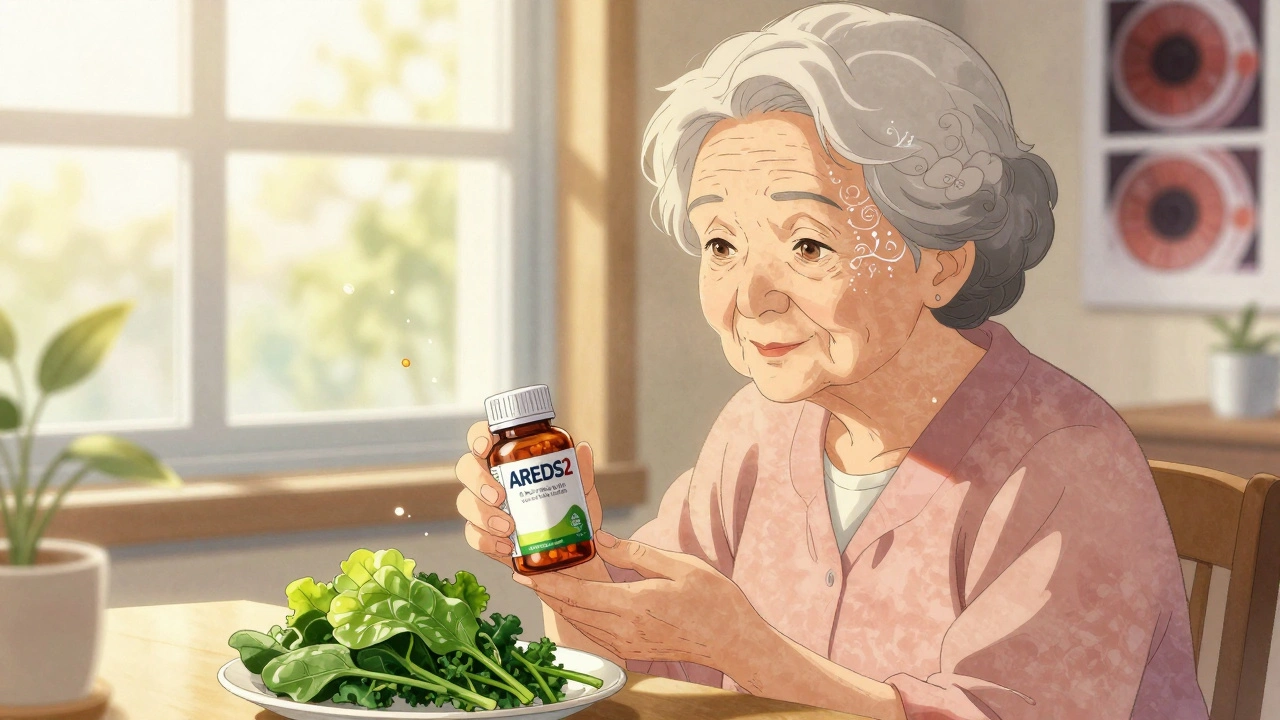

If you’ve been told you have intermediate age-related macular degeneration (AMD), you might have been handed a bottle of vitamins with a simple instruction: take these daily. But what are they really doing? And if you only have a few small spots on your retina-called drusen-should you be taking them too? The answer isn’t what most people assume.
What the AREDS2 Study Actually Found
The AREDS2 study wasn’t just another supplement trial. It was a decade-long, government-funded clinical trial involving nearly 4,000 people with varying stages of AMD. Run by the National Eye Institute, it aimed to improve the original AREDS formula from 2001-which had already shown it could cut the risk of vision loss by 25% in people with intermediate AMD.
The big change? They swapped out beta carotene for lutein and zeaxanthin. Why? Because beta carotene was linked to a 20% higher risk of lung cancer in people who smoked or used to smoke. That’s not a small trade-off. The new formula kept the same core ingredients: 500 mg vitamin C, 400 IU vitamin E, 80 mg zinc, and 2 mg copper. But instead of 15 mg of beta carotene, it added 10 mg lutein and 2 mg zeaxanthin.
And here’s the kicker: it worked better. A 10-year follow-up published in JAMA Ophthalmology in 2022 showed the AREDS2 formula reduced progression to late-stage AMD by 26%, slightly better than the original. More importantly, people taking lutein and zeaxanthin had no increased cancer risk. For smokers or former smokers, this wasn’t just an improvement-it was a lifesaver.
Who Should Take AREDS2 Vitamins?
This is where most people get it wrong. AREDS2 vitamins are not for everyone with blurry vision or aging eyes. They’re only for one specific group: people with intermediate AMD in one or both eyes, or those with advanced AMD (geographic atrophy) in one eye and intermediate AMD in the other.
What does intermediate AMD look like? It’s not just any spots. It means you have many medium-sized drusen, or at least one large drusen. Your eye doctor can see this during a dilated exam. If you only have a few small drusen-that’s early AMD-you won’t benefit from these pills. And if you don’t have AMD at all? Taking them won’t stop it from coming.
Multiple studies, including the 2023 analysis from Vision-and-Eye-Health.com, confirm this: AREDS2 supplements don’t prevent AMD. They don’t reverse damage. They don’t help people with early-stage disease. They only slow the jump from intermediate to late-stage disease.
And that’s critical. Late-stage AMD-especially the dry form called geographic atrophy-can cause severe, irreversible vision loss. If you’re in the intermediate stage, taking these vitamins daily might keep you from crossing that line for years longer.
What About Late-Stage AMD? New Evidence Changes Things
In July 2024, something unexpected happened. Researchers looked back at data from the original AREDS2 participants who had already developed geographic atrophy-the most advanced form of dry AMD. They scanned their retinas over three years and found something surprising: those taking the AREDS2 formula had a 55% slower rate of disease progression, as long as the damaged area wasn’t right in the center of the macula.
This is huge. Until now, doctors told people with late-stage AMD that vitamins wouldn’t help. But this new finding suggests that even if you’re already in the late stage, the formula might still slow the spread of damage. It doesn’t restore vision. It doesn’t fix what’s already gone. But it could help you keep your peripheral sight longer, which means you might stay independent longer-driving, reading, recognizing faces.
As Geraldine Hoad from the Macular Society said, these results are "encouraging." But they’re not yet a formal recommendation. More trials are needed. Still, for someone with late-stage AMD, this could mean the difference between needing full-time care and being able to live alone.

What’s in the Bottle? The Exact Formula
Not all "eye health" supplements are created equal. Many brands claim to support vision, but only a few match the AREDS2 formula. Here’s what you need to see on the label:
- 500 mg vitamin C
- 400 IU vitamin E
- 10 mg lutein
- 2 mg zeaxanthin
- 80 mg zinc (as zinc oxide)
- 2 mg copper (as cupric oxide)
Why copper? Because high doses of zinc can lower copper levels in your body. That’s why it’s included-to prevent anemia or nerve issues.
Don’t be fooled by products that say "AREDS2-style" or "similar to the AREDS formula." If it doesn’t list these exact numbers, it’s not the same. And if it has beta carotene? Walk away. Especially if you’ve ever smoked.
What About Omega-3s? B Vitamins? Other Supplements?
Many people think fish oil or B vitamins help with AMD. The science says otherwise.
The AREDS2 trial specifically tested adding omega-3 fatty acids (DHA and EPA) to the formula. Result? No benefit. Not even a tiny one. So if your supplement includes fish oil, it’s just padding the price.
As for B vitamins? Early studies hinted they might help prevent AMD, but the AREDS2 trial didn’t test them, and later research found no link. Dr. William Christen, who studied B vitamins in eye health, confirmed this: AREDS2 didn’t show any preventive effect.
Other antioxidants like astaxanthin or bilberry? No solid evidence yet. Stick to the proven formula.
Are There Side Effects? Is It Safe Long-Term?
The AREDS2 formula has been taken daily by thousands of people for over a decade. The 10-year follow-up showed no major safety issues. Zinc can cause mild stomach upset in some people. If that happens, try taking the pill with food.
High zinc doses can interfere with copper and iron absorption, but the 2 mg of copper in the formula prevents that. Long-term use hasn’t been linked to kidney problems, immune issues, or other common fears.
One thing to watch: if you’re on blood thinners, vitamin E can interact. Talk to your doctor if you take warfarin or other anticoagulants. And if you have a history of lung cancer or are still smoking-don’t take anything with beta carotene. Ever.
What If You Don’t Have Intermediate AMD?
Then don’t take them. Not because they’re dangerous-but because they don’t work.
People with early AMD (just a few small drusen) or no AMD at all see no benefit. Studies show no reduction in risk of developing AMD. No improvement in vision. No delay in progression.
Yet, millions buy these supplements hoping to "protect their eyes." It’s understandable. But it’s like taking insulin to prevent diabetes if you’re not diabetic. You’re spending money and taking pills for zero gain.
The real strategy? Eat more leafy greens. Spinach, kale, collards-they’re packed with lutein and zeaxanthin. If you’re eating those regularly, you might already be getting the nutrients you need. Supplements are only for when diet isn’t enough.
How to Take Them Right
Take one pill daily. No more. No less. Don’t double up if you miss a day. Just pick up the next day.
Take them with a meal that has some fat-like avocado, olive oil, or nuts. Lutein and zeaxanthin are fat-soluble. Without fat, your body absorbs less than half.
Stick with it. The benefit builds over years. Most people in the study stuck with it. 91% were still taking them after five years. That’s how you get the full effect.
And always get your AMD stage checked by an eye doctor before starting. Don’t guess. Don’t self-diagnose. A dilated eye exam is the only way to know if you’re in the right group.
Final Thought: It’s Not a Miracle, But It’s Real
AREDS2 vitamins aren’t magic. They won’t bring back lost vision. They won’t stop aging. They won’t help if you’re not in the right stage of disease.
But for the right person-someone with intermediate AMD-they’re one of the few proven tools we have to slow down a condition that steals sight slowly, silently, and without warning. And now, with new evidence suggesting they might help even in late-stage disease, their value is growing.
If you’ve been told you have intermediate AMD, ask your doctor about AREDS2. If you haven’t been diagnosed yet, don’t take them. Eat your greens. Get regular eye checks. And don’t fall for the hype. This isn’t about prevention. It’s about protection-for the people who need it most.
Elizabeth Grace
December 2, 2025 AT 00:16I took these for a year because my doc said so. My vision didn’t get worse, but I also didn’t feel any different. I just kept swallowing pills like they were candy. Now I eat spinach every day instead. Less expensive and I don’t feel like I’m poisoning myself with zinc.
Steve Enck
December 3, 2025 AT 11:37One must interrogate the epistemological foundations of nutritional interventionism. The AREDS2 paradigm, while statistically significant, remains a reductionist approximation of ocular homeostasis. To prescribe a pharmaceutical-grade micronutrient cocktail based on cohort data is to confuse correlation with causation-a fallacy as ancient as Hippocrates and as persistent as Big Pharma.
The human retina is not a circuit board to be calibrated with pill-form electrolytes. The body’s adaptive mechanisms, honed over millennia, are being pathologized by a medical-industrial complex that profits from perpetual supplementation. One must ask: who benefits? Not the patient. Not the eye. The shareholder.
Zed theMartian
December 4, 2025 AT 05:23Wow. So you’re telling me the entire medical establishment got it wrong for 20 years? That the NIH spent $100M to prove… what? That people who already have eye disease should take pills? Newsflash: people with bad eyes don’t need magic vitamins. They need better lighting, less screen time, and a doctor who doesn’t push supplements like a pharmacy clerk.
And now you’re saying it works for late-stage too? Cool. So the same pills that didn’t work before now magically work better? That’s not science. That’s a marketing reboot.
Ella van Rij
December 5, 2025 AT 21:23lol at the "10 mg lutein" like that’s some sacred number. My gummy vitamins have 5mg and they’re "eye health" too. Also, why does everyone assume I know what drusen are? I Googled it. Looks like little glitter balls in my eyeballs. Cool. Thanks for the visual.
Also, beta carotene = lung cancer? So if I smoked 20 years ago and now take AREDS2, I’m a walking time bomb? Or is it just the beta carotene that’s the problem? Like, if I ate a carrot, would I die? 🤔
ATUL BHARDWAJ
December 7, 2025 AT 16:39Indian eye doctors say eat spinach, turmeric, and avoid night driving. No pills needed. But in US, everyone needs a bottle. Simple.
Rebecca M.
December 8, 2025 AT 01:42So let me get this straight. I have to have a specific kind of blurry vision, diagnosed by a specialist, to get these pills… but millions of people buy them anyway because they’re scared of going blind? And we wonder why healthcare is so expensive?
Also, I’ve been taking these for 3 years. My cat can still see better than me. Just saying.
Lynn Steiner
December 8, 2025 AT 07:34MY MOM TOOK THESE AND NOW SHE CAN’T SEE HER GRANDKIDS. 😭 I’M SO ANGRY. WHY DIDN’T ANYONE TELL HER THEY DON’T WORK FOR EARLY STAGE?! SHE SPENT $80 A MONTH FOR 5 YEARS. I HATE THIS SYSTEM.
Alicia Marks
December 9, 2025 AT 11:07You’re not alone. If you’re unsure, talk to your eye doctor. They’re not selling pills-they’re trying to help you keep your sight. And if you’re eating greens, you’re already doing great. Keep going 💪
Paul Keller
December 9, 2025 AT 19:49Let’s be clear: the AREDS2 formula is not a panacea. It is a targeted, evidence-based intervention for a specific subset of patients with intermediate AMD. To generalize its utility beyond the clinical parameters defined in the trial is not only scientifically unsound-it is ethically irresponsible. The fact that this information remains misunderstood by the general public speaks volumes about the failure of medical communication in the age of social media.
Moreover, the 2024 follow-up data suggesting slowed progression in late-stage geographic atrophy, while preliminary, opens a promising avenue for future therapeutic development. This is not a miracle. It is incremental progress, built on rigorous science, and it deserves to be treated as such-not as a marketing slogan or a supplement aisle gimmick.
If you are not in the target group, you are not the intended beneficiary. That is not a criticism of you. It is a reflection of precision medicine. And it is better than the alternative: blanket recommendations that lead to unnecessary expense, false hope, and potential harm.
Shannara Jenkins
December 9, 2025 AT 23:54I love how this post breaks it down so clearly. I used to buy every "eye health" supplement until I found out I didn’t even have AMD. Now I just eat kale and wear sunglasses. So simple. So much cheaper. And honestly? I feel better knowing I’m not just throwing money at a bottle.
Jay Everett
December 11, 2025 AT 18:58Okay, real talk: I’m a 62-year-old who got diagnosed with intermediate AMD last year. Took AREDS2 for 18 months. My drusen didn’t grow. My vision stayed stable. I didn’t feel like a lab rat. I felt like I was doing something proactive. I don’t care if it’s not magic-I’ll take 26% slower progression over zero any day. 🙌
Also, I take mine with peanut butter toast. Fat = absorption. Learned that the hard way after taking them on an empty stomach and feeling like I swallowed a brick. 😅
मनोज कुमार
December 13, 2025 AT 11:02AREDS2 formula is placebo with zinc. No need. Eat green veg. Done. Also beta carotene is bad for smokers. Common sense. Why need study?
Joel Deang
December 14, 2025 AT 18:12Wait so if i eat kale i dont need the pills? like… at all? 😳 i’ve been buying the big bottle from walmart for 2 years. my mom said it was "for my eyes". i thought it was like a vitamin for computer people. guess i’m gonna start cooking now… 🥬
Roger Leiton
December 15, 2025 AT 01:53This is the most useful post I’ve read all year. I had no idea the formula was so specific. I thought all eye vitamins were basically the same. I’m going to check my label right now. Also, the fat-soluble tip? Game changer. I’ve been taking mine with coffee. No wonder I felt nothing. 😅
Laura Baur
December 16, 2025 AT 18:08It’s fascinating how society has been conditioned to equate health with consumption. We are told that every biological process can be optimized with a pill, that aging is a defect to be corrected rather than a natural phenomenon to be lived. The AREDS2 study, while methodologically sound, is still a symptom of a culture that outsources responsibility for well-being to pharmaceutical companies and medical authority figures.
What if the real solution was not a 500mg vitamin C tablet, but a life lived with less screen time, more natural light, and a diet rich in whole foods? What if we stopped treating the retina like a broken appliance and started treating the whole person? The fact that this isn’t the headline says everything about where our priorities lie.
And yet, for those who already have intermediate AMD, the formula remains a legitimate tool. But let’s not pretend it’s a cure. Or a prevention. Or a moral obligation. It’s a tool. Use it wisely-or don’t. But don’t let marketing make you feel guilty for choosing the latter.