


Drinking a glass of grapefruit juice in the morning might seem like a healthy habit-until it turns dangerous. For people taking certain medications, that refreshing citrus drink could be quietly turning a safe dose into a toxic one. It’s not about allergies or sugar. It’s about something deeper: how your body breaks down medicine. And grapefruit juice? It doesn’t just interfere-it blocks the system designed to keep you safe.
Why Grapefruit Juice Changes How Your Medicine Works
The problem starts in your gut. When you swallow a pill, your body doesn’t just absorb it whole. A group of enzymes called CYP3A4, mostly found in the lining of your small intestine, normally breaks down about half of all oral medications before they even reach your bloodstream. This is a natural filter. It keeps drug levels from spiking too high, too fast. Grapefruit juice doesn’t just bypass this filter-it shuts it down. The juice contains chemicals called furanocoumarins, mainly bergamottin and 6',7'-dihydroxybergamottin. These compounds bind to CYP3A4 enzymes and permanently disable them. Once they’re knocked out, your body can’t break down the drug the way it should. That means more of the drug enters your blood, and it stays there longer than intended. The FDA calls this "increased bioavailability." Doctors call it a recipe for trouble. Here’s the scary part: one 200-milliliter glass-about six ounces-can reduce CYP3A4 activity by nearly half within four hours. And it doesn’t wear off quickly. It takes 24 to 72 hours for your body to make new enzymes. That means even if you take your medicine at night and drink grapefruit juice in the morning, you’re still at risk. The window of danger is long. The FDA says you must avoid grapefruit for the entire time you’re on the medication-not just around your dose.Which Medications Are Most at Risk?
Not all drugs are affected equally. But for some, the interaction isn’t just risky-it’s deadly. As of 2023, more than 85 prescription medications are known to interact with grapefruit juice. Of those, 43 can cause life-threatening reactions. Statins are among the most common offenders. Simvastatin (Zocor), used to lower cholesterol, is especially dangerous. A daily glass of grapefruit juice can triple blood levels of simvastatin. That pushes the risk of rhabdomyolysis-a condition where muscle tissue breaks down and floods your kidneys-with deadly consequences-from 0.04 cases per 100 people per year to 0.44. That’s more than a tenfold increase. Atorvastatin (Lipitor) is less affected, with only a 1.3-fold rise in concentration. But pravastatin and rosuvastatin? They’re safe. No interaction. If you’re on simvastatin and drink grapefruit juice, talk to your doctor about switching. Calcium channel blockers used for high blood pressure also show wide variation. Felodipine (Plendil) sees a fivefold spike in blood levels. Nifedipine (Procardia) jumps 3.3 times. But amlodipine (Norvasc)? Almost no change. The difference isn’t random-it’s about how each drug is processed. If your doctor prescribed one of these, don’t assume they’re all the same. Immunosuppressants like cyclosporine (Neoral), used after organ transplants, can increase exposure by 50-60%. That raises the risk of kidney damage, high blood pressure, and tremors. A single grapefruit juice might not cause immediate harm, but over weeks or months, it can quietly wreck your transplanted organ. Antiarrhythmics like amiodarone (Cordarone) can cause dangerous heart rhythms if grapefruit juice raises levels too high. Studies show plasma concentrations climb 30-40%. That’s enough to trigger ventricular tachycardia or torsades de pointes-both can be fatal.What About Other Citrus Fruits?
Not all citrus is the same. Seville oranges-used in marmalade-and pomelos contain the same furanocoumarins as grapefruit. So if you’re on a risky medication, skip those too. Sweet oranges (like navel or Valencia), tangerines, and lemons? They’re safe. They don’t contain enough of the bad chemicals to cause trouble. The European Medicines Agency confirmed this in March 2022. You can still enjoy orange juice with your meds. Just stay away from anything that looks or tastes like grapefruit. That includes hybrid fruits like tangelos or orangelos if they’re grapefruit crosses.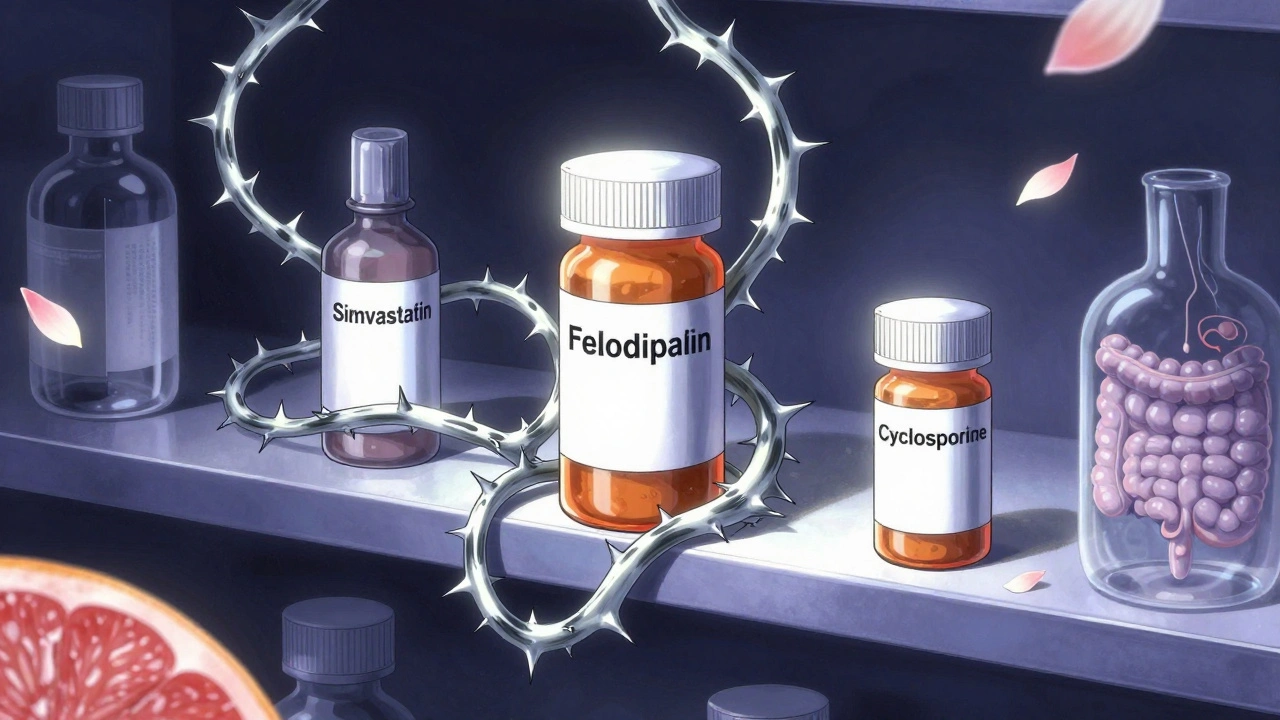
Who’s Most at Risk?
Older adults are hit hardest. People over 65 make up 40% of grapefruit juice drinkers in the U.S., according to USDA surveys. They’re also the group most likely to be on three to five medications at once. Many of those are the exact drugs that interact badly with grapefruit-statins, blood pressure pills, anti-anxiety meds. But age isn’t the only factor. Some people naturally have higher levels of CYP3A4 in their guts. When grapefruit juice knocks those out, their drug levels skyrocket. Others have lower baseline levels, so the effect is smaller. There’s no test to know which group you’re in. That’s why experts say: if your medication is on the list, avoid grapefruit entirely. No guessing.What Should You Do?
Step one: Check your meds. Look at your prescription labels. If they say "avoid grapefruit" or "do not consume grapefruit products," that’s not a suggestion-it’s a warning. About 76% of affected drug labels now include this language, thanks to FDA requirements since 2014. Step two: Talk to your pharmacist. They’re trained to catch these interactions. A 2021 study found that 89% of community pharmacists routinely screen for grapefruit juice when dispensing medications. Don’t assume your doctor told you. Many patients don’t remember being warned-only 38% recall getting the advice, according to a 2022 survey. Step three: Keep a full list. Include every pill, supplement, and over-the-counter drug you take. Some antihistamines like fexofenadine (Allegra) interact too. So do certain antidepressants, sedatives, and even some cancer drugs. Your pharmacist needs the full picture. Step four: Ask about alternatives. If you’re on simvastatin, ask if pravastatin or rosuvastatin would work. If you’re on cyclosporine, could tacrolimus be an option? These switches are common and often safe. Many patients don’t realize alternatives exist.
What About Juices, Smoothies, and Supplements?
It’s not just about straight juice. Grapefruit extract in supplements, smoothies with grapefruit pulp, or even flavored water with grapefruit essence can trigger the interaction. Fresh-squeezed has the strongest effect, but pasteurized juice still contains enough furanocoumarins to be dangerous. The same goes for grapefruit-flavored candies or syrups. Don’t assume "natural" means safe. The chemicals causing the problem are naturally occurring. They’re not additives. They’re in the fruit itself.Is There Hope for the Future?
Yes. Scientists are working on solutions. In October 2023, the USDA announced that CRISPR-edited grapefruit with 90% less furanocoumarin had passed Phase 1 safety trials. These aren’t genetically modified organisms in the old sense-they’re edited to turn off the genes that make the bad chemicals. If approved, they could offer a safe grapefruit option in the next 5-10 years. But until then? The advice is simple: if your medication interacts with grapefruit, skip it. No exceptions. No "just a little." No "I didn’t feel anything last time." The interaction doesn’t always cause symptoms right away. It just quietly builds up risk-until it doesn’t.Frequently Asked Questions
Can I drink grapefruit juice if I take my medication at night?
No. The enzymes in your gut that grapefruit juice disables take 24 to 72 hours to regenerate. Even if you take your medicine at night and drink grapefruit juice in the morning, you’re still at risk. The interaction isn’t about timing-it’s about the lasting effect on your body’s ability to process the drug. Avoid grapefruit entirely while on affected medications.
Does grapefruit juice affect all statins the same way?
No. Simvastatin (Zocor) is the most dangerous-just one glass can triple blood levels. Atorvastatin (Lipitor) increases by about 1.3 times, which is less risky but still not safe. Pravastatin and rosuvastatin show no significant interaction. If you’re on a statin and drink grapefruit juice, ask your doctor if switching to a safer option is possible.
Are other citrus fruits dangerous too?
Seville oranges (used in marmalade) and pomelos contain the same harmful chemicals as grapefruit and should be avoided. Sweet oranges, tangerines, lemons, and limes are safe. Always check the label on orange juice-some brands use Seville oranges. If it says "bitter orange" or "marmalade orange," skip it.
What if I accidentally drank grapefruit juice while on medication?
If it was a one-time mistake, don’t panic. But monitor yourself for unusual symptoms like unexplained muscle pain, weakness, dizziness, irregular heartbeat, or nausea. These could signal a serious reaction. Call your doctor or pharmacist. Going forward, avoid grapefruit completely. The risk isn’t in the one-time event-it’s in repeated exposure.
Can I take grapefruit juice with over-the-counter meds?
Yes, some OTC drugs interact too. Fexofenadine (Allegra) is affected, and so are certain sleep aids and antihistamines. Always read the label. If you’re unsure, ask your pharmacist. Just because something is sold without a prescription doesn’t mean it’s safe with grapefruit.
Why don’t doctors always warn patients about this?
Many do-but not all. A 2022 survey found only 38% of patients recalled being warned. Doctors are busy. Labels can be overlooked. Pharmacists are better at catching this during dispensing. That’s why it’s up to you to ask: "Does this medicine interact with grapefruit?" Don’t wait for them to bring it up.
Is there a test to know if I’m at higher risk?
No. Some people naturally have more CYP3A4 enzymes in their gut, so grapefruit juice affects them more. Others have less, so the effect is smaller. There’s no routine test to measure this. That’s why experts say: if your drug is on the list, avoid grapefruit. No exceptions.
Shayne Smith
December 7, 2025 AT 14:16So I’ve been drinking grapefruit juice with my blood pressure meds for years and I’m fine? Guess I’m one of the lucky ones who didn’t get turned into a human popsicle.
Billy Schimmel
December 8, 2025 AT 05:09Yeah right. Next they’ll tell us coffee kills your kidneys and water gives you cancer. They want you scared so you buy their ‘safe’ alternatives.
Max Manoles
December 8, 2025 AT 15:47The science here is rock-solid. Furanocoumarins irreversibly inhibit CYP3A4 in the intestinal epithelium - this isn’t speculation, it’s pharmacokinetics. The 24–72 hour enzyme regeneration window is clinically documented. This isn’t fearmongering; it’s biochemistry.
And the statin data? Simvastatin’s AUC increases by up to 300% with grapefruit juice. That’s not a ‘maybe,’ that’s a red flag flashing in the ER.
People treat this like a dietary myth. It’s not. It’s a silent killer hiding in your smoothie.
Also - if you’re on cyclosporine and think ‘I only drink it once a week’ - you’re playing Russian roulette with your transplant.
And yes, Seville oranges are just as bad. Pomelos? Same. Even ‘natural’ grapefruit extract in supplements? Still dangerous.
It’s not about taste. It’s about enzyme kinetics. Stop guessing. Stop rationalizing. Just read the label.
And if your doctor didn’t warn you? That’s not their fault. It’s systemic. Pharmacists catch 89% of these - doctors? Less than half.
So ask. Always. Before you sip.
Clare Fox
December 10, 2025 AT 04:51so like... if my body just makes more of those enzymes, does that mean i'm basically a superhuman when it comes to meds? or am i just a walking time bomb that doesn't know it yet?
also why is it that every time someone says 'natural' it turns into a death trap? like, i get it, poison ivy is natural too but nobody's sippin' that with their tylenol.
also why do we even have grapefruit if it's just a chemical weapon disguised as breakfast?
Arjun Deva
December 11, 2025 AT 02:36Jackie Petersen
December 13, 2025 AT 01:44Why do we even listen to the FDA? They’re just a branch of the same corporate machine that gave us opioids and Roundup. Grapefruit is perfectly safe. It’s the pills that are the problem - not the fruit.
Also, why are we letting scientists edit fruits? Next they’ll make sugar taste like broccoli. This is fascism.
Kumar Shubhranshu
December 14, 2025 AT 04:01Nava Jothy
December 14, 2025 AT 15:56Oh my god. I just realized I’ve been drinking grapefruit juice with my cyclosporine for 8 months. 😭 I’m basically a walking organ failure waiting to happen. I’m so naive. I thought ‘natural’ meant ‘good.’ I’m such a fool. 🙈
Also, I just switched to organic cold-pressed juice. Does that make it worse? Or better? I’m so confused now. 😭
Kenny Pakade
December 16, 2025 AT 12:24So let me get this straight - we’re banning a fruit because some scientist in a lab said it ‘interacts’? What’s next? Banning sunlight because it makes your skin age? This is why America’s dying. We’re scared of everything.
Also, why are Indians even allowed to comment on this? They eat spicy food with their meds and still walk around like it’s nothing.
olive ashley
December 17, 2025 AT 07:50Wow. So we’re just supposed to trust the label? What if the label is wrong? What if the pharmacist is tired? What if your doctor forgot? You think they care? They’re just trying to hit their quota.
And don’t even get me started on supplements. I took a ‘natural’ grapefruit extract for ‘detox’ and now I’m paranoid I’ve ruined my liver. I don’t trust anything anymore.
Also - why is everyone acting like this is new? My grandma used to say ‘fruit is poison if you’re on pills’ back in the 70s. Nobody listened then either.
Ibrahim Yakubu
December 19, 2025 AT 00:24This is why Africans don’t get heart disease. We don’t drink juice. We eat the whole fruit. We don’t let chemicals control us. We are not weak like Americans who need pills to fix everything they eat.
Also, grapefruit is a Western fruit. It doesn’t belong in our bodies. Our ancestors never drank it. Why are you forcing this on us?
Saketh Sai Rachapudi
December 20, 2025 AT 15:15joanne humphreys
December 20, 2025 AT 19:39I appreciate how detailed this is. I didn’t know grapefruit could affect so many meds - I thought it was just statins. I’m going to check my list tonight. I also never realized that even grapefruit-flavored water could be dangerous. Thank you for the clarity.
Also - I’m glad they’re working on CRISPR grapefruit. That’s actually kind of beautiful. Science helping us keep the flavor without the risk.