
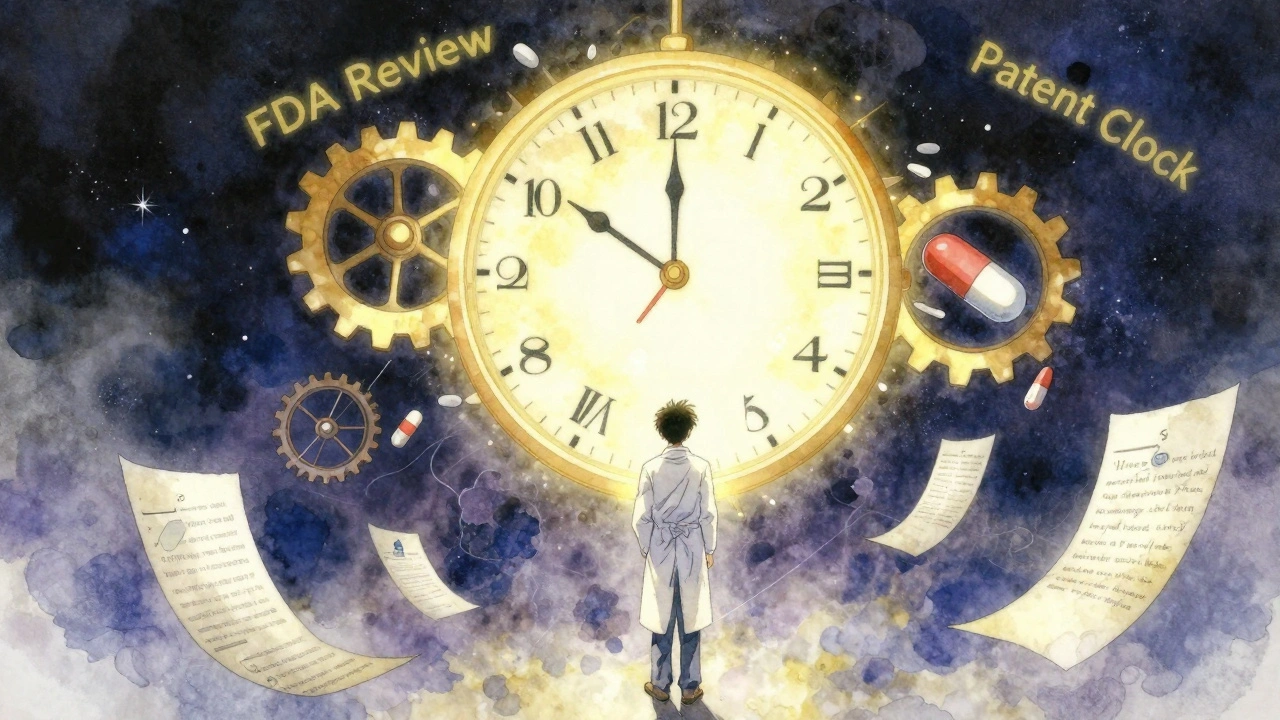

Imagine spending 12 years and $2.6 billion to develop a new drug-only to find out you’ve got less than 10 years left on your patent by the time the FDA finally approves it. That’s not a hypothetical. It’s the reality for most pharmaceutical companies. Patent Term Restoration (PTE) exists to fix that broken clock. It’s not a loophole. It’s a legal reset button for patents that got eaten up by bureaucracy.
Why Patent Term Restoration Even Exists
The U.S. patent system gives inventors 20 years of protection from the day they file. Sounds fair, right? But for drugs, medical devices, and food additives, the clock starts ticking long before the product even hits the market. The FDA review process can take 8 to 15 years. By the time a drug gets approved, half the patent life is already gone. That’s not just bad luck-it’s a financial death sentence. Without PTE, companies wouldn’t recoup their investment. No one would risk developing new treatments. The solution came in 1984 with the Hatch-Waxman Act. Named after Senator Orrin Hatch and Representative Henry Waxman, this law didn’t just give drug makers more time-it balanced it with faster access to generics. The goal? Keep innovation alive while keeping prices down. PTE lets patent holders get back some of the time lost during regulatory review. But it’s not automatic. And it’s not for everyone.What Products Qualify for PTE
Not every patent can be extended. Only specific types of products qualify:- Human drugs (including new chemical entities and new formulations)
- Medical devices
- Food additives
- Color additives
- Animal drugs (added in 1988)
How the Extension Is Calculated
The math behind PTE is complex, but here’s the basic formula:Extension = (Regulatory Review Period) − (Pre-Grant Review Period) − (Days of Applicant’s Delay) − ½ (Total Patent Term − Pre-Grant Patent Term)
In plain terms:- Regulatory Review Period: The total time from when you submit your application to the FDA until they approve it.
- Pre-Grant Review Period: The time between your patent filing and the FDA application submission.
- Applicant’s Delay: Any time you caused the delay-like missing a deadline or not responding to FDA questions fast enough.
- You can’t get more than five years added to your patent.
- Your total patent life-original term plus extension-can’t go beyond 14 years from FDA approval.
When and How to Apply
Timing is everything. You have just 60 days after FDA approval to file your PTE application with the USPTO. Miss that window, and you lose your chance forever. No exceptions. The process isn’t just paperwork. You need to prove you didn’t waste any time. The FDA requires day-by-day documentation of every step: when you submitted data, when you responded to questions, when you updated your application. If you can’t show continuous progress, your application gets denied. In 2022, over 12% of PTE applications were rejected-mostly because of poor recordkeeping. You also need to file with both agencies:- FDA: They calculate your regulatory review period and send the data to the USPTO.
- USPTO: They review your patent, check eligibility, and issue the final extension.
Interim Extensions: A Lifeline for Late-Stage Drugs
What if your patent expires in six months, but the FDA still hasn’t approved your drug? You’re out of luck-unless you apply for an interim extension. This is a temporary fix. You can file for it between six months and 15 days before your patent expires. If approved, it keeps your patent active while you wait for final FDA action. It’s not a full extension-it’s insurance. Once the FDA approves your product, the interim extension turns into the full PTE. This tool is critical for drugs in Phase 3 trials. Without it, companies would have to stop development just because their patent ran out. Interim extensions keep the pipeline flowing.Who Uses PTE-and Who Abuses It
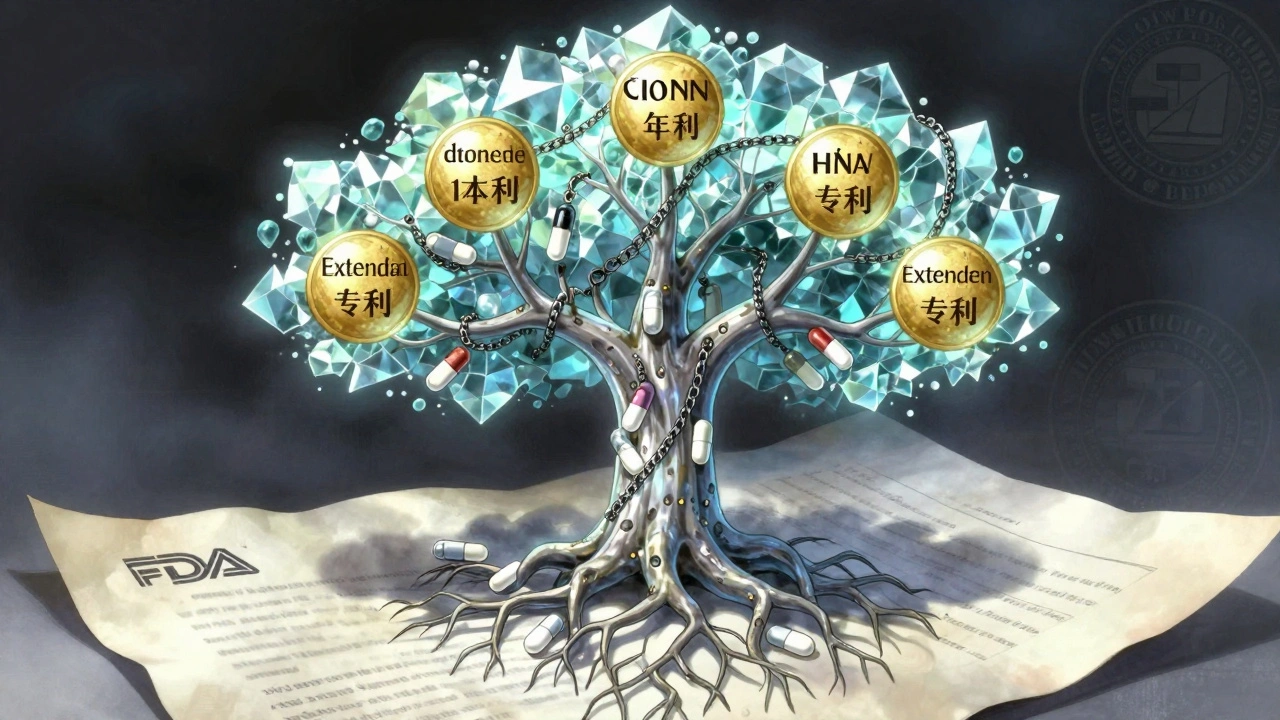
PTE was designed to help innovators. But in practice, it’s become a strategic weapon. In 2023, 34% of PTE applications were for biologics-complex drugs made from living cells. These are expensive to develop and hard to copy. Companies are using PTE to lock in exclusivity for these high-margin products. But here’s the problem: 78% of PTE applications now involve secondary patents-not the original compound patent. Think of it like this: You patent the drug molecule. Then you patent its delivery system. Then you patent its dosage form. Then you patent its use for a new disease. Each one gets its own PTE. That’s called a “patent thicket.” It’s legal. But it delays generics for years beyond what Congress intended. A 2022 Yale study found that 91% of drugs that got PTE still held market dominance years after the extension expired-thanks to these secondary patents. The FTC says drugs with PTE keep 92% of their market share during the extension. After generics enter, that drops to 37%. That’s not competition-that’s a monopoly with a timer.What’s Changing in 2025 and Beyond
The system is under pressure. The Government Accountability Office (GAO) is releasing its full review of PTE in December 2025. Congress is considering the Preserve Access to Affordable Generics and Biosimilars Act, which would block PTE for secondary patents unless they meet strict new criteria. The FDA is also modernizing. By mid-2026, they plan to roll out a digital submission system for PTE applications. That should cut processing times and reduce errors. Right now, companies still submit paper forms, spreadsheets, and scanned emails. It’s a mess. Meanwhile, PTE applications are rising. In 2023, the USPTO received 312 requests-up 7.3% from the year before. Biologics, gene therapies, and regenerative medicines are driving the growth. The total revenue impact? Over $127 billion projected through 2028.
Is PTE Fair?
It depends on who you ask. For a small biotech startup that spent a decade developing a cure for a rare disease, PTE is the only reason they can survive. Without it, investors walk away. For a big pharma company that uses PTE to delay 10 different generics for a single drug, it’s a profit-maximizing tactic. The public pays more. Patients wait longer. The law was meant to strike a balance. But over time, the scales tipped. The system works exactly as written-but not as originally intended.What You Need to Do If You’re Applying
If you’re in pharma, medtech, or biotech and thinking about PTE:- Start tracking every FDA interaction from day one. Use a digital log. Don’t rely on memory.
- Coordinate your patent team and regulatory team. Poor communication causes 43% of delays.
- File your PTE application within 60 days of FDA approval-no exceptions.
- Consider an interim extension if your patent is about to expire and approval is pending.
- Work with a patent attorney who specializes in PTE. It’s not standard patent law. Most attorneys need 18-24 months of training to get it right.
Final Thought
Patent Term Restoration isn’t about gaming the system. It’s about fixing a mismatch between two systems: patent law and drug regulation. One moves fast. The other moves slow. PTE tries to bridge that gap. But it’s a tool. And tools can be used well-or used to harm. The future of PTE won’t be decided by lawyers or patent offices. It’ll be decided by whether society still believes innovation deserves protection-or if the cost of that protection has become too high.Can I extend a patent for a medical device under PTE?
Yes. Medical devices that require FDA premarket approval (PMA) or 510(k) clearance are eligible for Patent Term Restoration. The device must be subject to a regulatory review period before commercial marketing. This includes implantable devices, diagnostic tools, and surgical instruments that go through formal FDA evaluation. However, over-the-counter devices with no premarket review (like basic bandages or thermometers) do not qualify.
How long does the FDA take to process a PTE application?
The FDA doesn’t grant the extension-they calculate the regulatory review period and send the data to the USPTO. That process takes about 90-120 days on average. The USPTO then takes another 90-120 days to review the patent and issue the final extension. Total processing time is typically 217 days, according to FDA’s 2023 annual report.
Can I get PTE for a drug that’s already on the market?
No. You must apply within 60 days of FDA approval. If the drug has been on the market for more than 60 days, you’re no longer eligible. The law is strict on this timing. There are no retroactive extensions, even if the delay was caused by the FDA.
What’s the difference between PTE and PTA?
PTE (Patent Term Extension) compensates for delays caused by the FDA during drug or device approval. PTA (Patent Term Adjustment) compensates for delays caused by the USPTO during patent examination. PTE is about regulatory review; PTA is about patent office backlog. They’re two separate programs with different rules and agencies involved.
Can I extend multiple patents for the same drug?
No. Only one patent per product can receive a PTE extension. But that patent doesn’t have to be the original compound patent-it can be a method-of-use patent or a formulation patent. The key is that only one extension is allowed per regulatory review period. This is why companies often file multiple patents and strategically choose which one to extend.
Do generic manufacturers challenge PTE extensions?
Yes. Generic companies often file legal challenges if they believe a PTE was improperly granted-especially when it’s based on a secondary patent. Courts have ruled that extensions must be tied to the actual product approved by the FDA, not just any patent claim. The 2024 Eli Lilly v. USPTO case tightened the rules on proving due diligence during pre-approval, making it harder to get full extensions.
If you’re developing a regulated product and your patent is nearing expiration, don’t wait. Start documenting now. The difference between a 5-year extension and zero could mean the difference between keeping your company alive or shutting down.
Rawlson King
December 13, 2025 AT 03:02And don't get me started on secondary patents. It's patent trolling with a FDA stamp.
Casey Mellish
December 14, 2025 AT 06:26Tyrone Marshall
December 14, 2025 AT 22:37PTE is a band-aid on a hemorrhage. We need a complete overhaul: patent terms tied to clinical impact, not calendar days. Reward cures, not legal loopholes.
Emily Haworth
December 15, 2025 AT 11:55Tom Zerkoff
December 17, 2025 AT 09:28Yatendra S
December 18, 2025 AT 08:13Himmat Singh
December 18, 2025 AT 09:49kevin moranga
December 19, 2025 AT 17:17Don’t throw the baby out with the bathwater. Fix the abuse. Don’t kill the tool. Talk to the small labs. They’re the ones who need this to survive.
Jamie Clark
December 21, 2025 AT 03:44Wake up. This isn’t innovation. It’s rent-seeking.
Keasha Trawick
December 21, 2025 AT 03:48And don’t even get me started on the ‘interim extension’-it’s like a legal life support for patents on life support. Companies are playing chess with human lives, and the board is made of FDA forms and USPTO stamps. It’s grotesque. And beautiful. And terrifying.
Webster Bull
December 21, 2025 AT 10:30Bruno Janssen
December 22, 2025 AT 14:15Emma Sbarge
December 23, 2025 AT 01:34