

When you pick up a prescription, you might not realize you’re choosing between two very different kinds of drugs - and that choice can save you hundreds of dollars a month. One is made by just one company with no competitors. The other is made by many, often at a fraction of the cost. Understanding the difference between single-source and multi-source drugs isn’t just about pharmacy jargon - it’s about your wallet, your health, and your right to know what you’re really paying for.
What Exactly Is a Single-Source Drug?
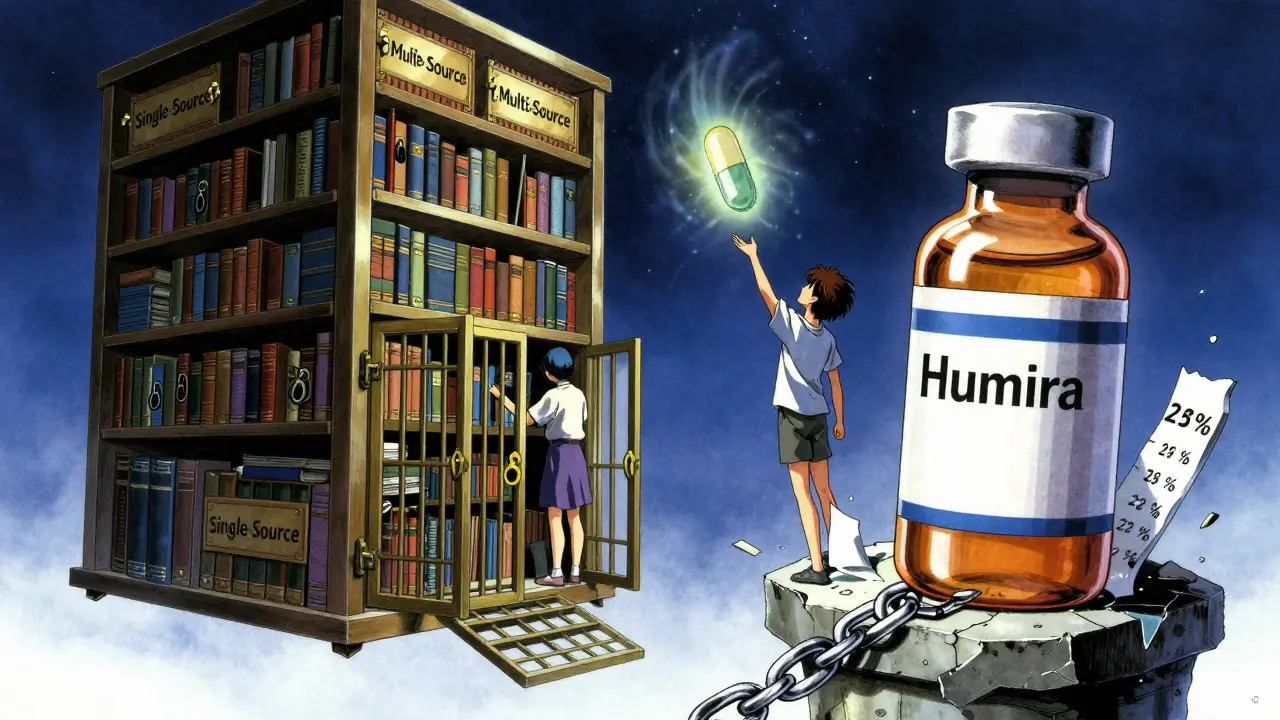
A single-source drug is a medication that only one company is allowed to make. Usually, that’s because it’s still under patent protection or has some kind of exclusive marketing rights. These are often brand-new treatments - think cutting-edge cancer drugs, rare disease therapies, or advanced biologics. You won’t find a cheaper version at your local pharmacy because, legally, no one else can make it yet.These drugs carry a special label in pharmacy systems: the 'N' code in Medi-Span’s MONY classification. That means no generics exist. If your doctor prescribes Humira before 2023, you were getting a single-source drug. After 2023, when biosimilars entered the market, it became multi-source. That shift didn’t just change the name on the bottle - it changed the price.
Single-source drugs are expensive. The average list price is much higher than generic alternatives. But here’s the twist: even though they cost more, the rebate system means the real price paid by insurers doesn’t always reflect that. According to research from the USC Schaeffer Center, when there’s no generic competition, manufacturers raise list prices and rebates in lockstep - dollar for dollar. That means your insurance pays more, but you? You still pay the full sticker price at the counter if you’re not covered well.
What Makes a Drug Multi-Source?
Multi-source drugs are the opposite. They’re available as both the original brand and multiple generic versions made by different companies. Think of drugs like lisinopril for high blood pressure or metformin for diabetes. You’ve probably seen different labels on the same pill - Teva, Mylan, Sandoz - all making the same thing.These drugs are marked with an 'O' (brand with generics) or 'Y' (generic-only) in the MONY system. The FDA requires every generic version to prove it’s bioequivalent to the brand. That means it delivers the same active ingredient, in the same strength, the same way - and your body absorbs it within 80% to 125% of the brand’s rate. That’s not a guess. It’s a strict scientific standard.
Over 86% of prescriptions filled in the U.S. are for multi-source drugs, according to the National Center for Biotechnology Information. But here’s what most people don’t realize: even though generics make up most of the prescriptions, they only account for about 23% of total drug spending. That’s because single-source drugs are so expensive - one can cost more than a hundred generics combined.
Why Do Prices Differ So Much?
The price gap isn’t just about manufacturing. It’s about competition.With a single-source drug, the manufacturer has a monopoly. They can set prices high and keep them there. The average monthly cost for a single-source drug is around $587, according to a 2022 Kaiser Family Foundation survey. For multi-source drugs? Just $132. That’s more than a 77% savings.
But here’s the catch: even with generics, prices aren’t always low. Some insurers use something called Maximum Allowable Cost (MAC), which caps how much they’ll pay for a generic. That means pharmacies might get paid less than $5 for a 30-day supply - and if your co-pay is $10, you’re still paying more than the pharmacy is getting.
And then there’s the rebate system. Drugmakers give big discounts to pharmacy benefit managers (PBMs) - the middlemen between insurers and pharmacies. But those discounts rarely reach you. As Dr. Erin Trish from USC put it: “Higher list prices generate larger rebates, but these savings rarely translate to lower out-of-pocket costs for patients.” So you’re stuck paying the full price, while insurers and PBMs negotiate behind the scenes.
Are Generic Drugs Really the Same?
The FDA says yes. All approved generics must meet the same quality, safety, and effectiveness standards as the brand. The active ingredient is identical. The dosage form is the same. The route of administration - whether pill, injection, or patch - doesn’t change.But patients report differences. On Drugs.com, multi-source drugs average a 4.2 out of 5 rating, compared to 4.5 for brand-name drugs. Why the gap? About 68% of negative reviews mention “inconsistent effectiveness between generic manufacturers.”
That doesn’t mean the FDA’s standards are wrong. It means the inactive ingredients - the fillers, dyes, coatings - can vary. For most people, that doesn’t matter. But for some, especially with drugs that have a narrow therapeutic index (like warfarin, levothyroxine, or seizure meds), even small changes in how the drug is absorbed can cause side effects or reduced effectiveness.
If you notice your symptoms changing after switching generics, talk to your pharmacist. Ask: “Did the manufacturer change?” If so, you can request the same brand you had before. Pharmacists can often honor that request, especially if you explain your experience.
What Does Your Insurance Really Cover?
Your insurance plan doesn’t treat single-source and multi-source drugs the same. Single-source drugs are usually on higher tiers - meaning higher co-pays or coinsurance. You might even need to try cheaper alternatives first (called step therapy) before your plan will pay for the brand.For example, if your doctor prescribes a single-source insulin, your insurer might require you to try a generic version first - even if you’ve been stable on the brand for years. That can mean switching medications, adjusting doses, and risking your health.
On the flip side, multi-source drugs are often preferred. Many plans will only cover the generic version. In some cases, they won’t cover the brand at all unless you get prior authorization. That’s why you might get a letter from your insurer saying, “We’re switching you to the generic.”
Don’t panic. Ask your pharmacist: “Is this the same medication?” and “Can I get the brand if I need it?” You have rights. You can appeal. You can ask for exceptions.
What Should You Do as a Patient?
Here’s a simple checklist to protect yourself:- Know your drug’s status. Ask your pharmacist: “Is this single-source or multi-source?” If it’s single-source, ask if a generic is coming soon.
- Check your co-pay. Compare the cost of the brand vs. the generic. Sometimes the difference is $500 a month.
- Ask about the manufacturer. If you’ve had issues with one generic, ask for the same one next time. Write it down. Bring it up every refill.
- Use the FDA’s Orange Book. It lists therapeutic equivalence codes (like “AB”) for multi-source drugs. Look up your drug there - it tells you which generics are approved as interchangeable.
- Don’t assume generics are always cheaper. Some “single-source generics” - where one company has exclusive rights - aren’t much cheaper than the brand. Ask your pharmacist: “Is this the only generic available?”
The FDA estimates generic drugs saved Americans $1.7 trillion over the last decade. That’s real money. But savings only happen if you know how to ask for them.
What’s Changing in 2026?
The FDA’s Generic Drug User Fee Amendments (GDUFA III), launched in 2023, aims to cut generic approval times to just 10 months by 2025. That means more single-source drugs will become multi-source faster - especially in areas like diabetes, heart disease, and mental health.Pharmaceutical companies are also using “authorized generics” - where the brand-name maker releases its own generic version. This lets them keep profits while appearing to support lower prices. It’s a smart business move, but it doesn’t always help patients. If your insurer only covers the authorized generic, you’re still paying more than you would for a true independent generic.
And with the Inflation Reduction Act’s new rebates for Medicare Part D, single-source drugs are under more pressure. Insurers are pushing harder to switch patients to generics - even if it means changing your treatment plan.
You’re not powerless in this system. You have the right to ask questions. You have the right to know what you’re getting. And you have the right to demand better prices.
Next time you get a prescription, don’t just take it. Ask: Is this the cheapest version? Is it the same as last time? Can I switch to a generic? That one conversation could save you hundreds - and give you real control over your care.