


When pancreatic cancer shows up, it often sneaks in quietly. Unlike some cancers that give warning signs early, pancreatic cancer hides behind vague symptoms that many people brush off as stress, aging, or a bad case of indigestion. By the time it’s found, it’s usually spread too far to be cured. But that doesn’t mean there’s no hope. In the last five years, we’ve seen real progress - in how we spot it early and how we treat it when we do. If you or someone you care about is dealing with unexplained weight loss, new-onset diabetes, or persistent pain, it’s worth paying attention. This isn’t about fear. It’s about knowing what to look for and what’s now possible.
What Early Pancreatic Cancer Actually Feels Like
Most people don’t realize how subtle the early signs of pancreatic cancer can be. They don’t come with a red flag. They come as whispers. A 65-year-old man thinks he’s just gaining weight from comfort eating. A 58-year-old woman blames her fatigue on menopause. Neither connects the dots - until it’s too late. According to data from the Pancreatic Cancer Action Network, 80% of cases are diagnosed at stage III or IV. That’s because the pancreas sits deep in the abdomen, behind the stomach. Tumors there don’t cause pain until they’re large or pressing on nerves. But before that, there are clues:- Unexplained weight loss - losing 10 pounds or more without trying happens in about 60% of cases. It’s not just appetite loss - your body starts breaking down muscle and fat even if you’re eating normally.
- Abdominal or back pain - this isn’t a cramp. It’s a dull, constant ache that wraps around your midsection or shoots into your lower back. It often gets worse after eating or when lying down.
- Jaundice - yellowing of the skin or whites of the eyes. This happens when a tumor blocks the bile duct. It’s often the first sign in tumors near the head of the pancreas. Look for dark urine, pale stools, and intense itching - these are all linked to bile buildup.
- New-onset diabetes - if you’ve never had diabetes before and suddenly your blood sugar spikes, it could be a signal. Research from Columbia University shows that 80% of pancreatic cancer patients develop diabetes within 18 months before diagnosis. Fasting glucose jumps from normal (under 100 mg/dL) to diabetic levels (over 126 mg/dL) in as little as six months.
- Changes in digestion - stools that float, look greasy, or smell unusually foul suggest your body isn’t digesting fat properly. That’s because the pancreas isn’t releasing enough enzymes.
- Depression or anxiety - this one is surprising. A 2018 study found that nearly half of pancreatic cancer patients had mood changes before physical symptoms. In some cases, depression was their first warning sign, appearing six months before diagnosis.
These signs don’t mean you have cancer. But if three or more show up together - especially weight loss, new diabetes, and jaundice - it’s time to push for testing.
Why Diagnosis Is So Hard
The pancreas is hard to see. Routine blood tests won’t catch it. A physical exam won’t feel a tumor. Even a standard CT scan misses small tumors - only 60% of those under 2 cm are visible. That’s why most people get diagnosed late. The gold standard for diagnosis today is a combination of imaging and biopsy. A CT scan with contrast is usually the first step. It’s good for spotting tumors larger than 3 cm. But for smaller ones, an endoscopic ultrasound (EUS) is better. A thin scope with a sound probe is passed through the mouth into the stomach, right next to the pancreas. From there, doctors can take a tiny tissue sample with a needle - and get a 95% accurate diagnosis. Blood tests like CA 19-9 are often ordered, but they’re not reliable for early detection. They’re elevated in 70-90% of advanced cases, but only 30-50% of early ones. They’re more useful for tracking how well treatment is working than for finding cancer in the first place. There’s no screening test for the general public. That’s because pancreatic cancer is rare - about 13 cases per 100,000 people. But for those at high risk - people with BRCA gene mutations, hereditary pancreatitis, or a strong family history - annual EUS and MRI scans starting at age 50 are recommended. Johns Hopkins has been doing this since 2010, and it’s catching cancers when they’re still curable.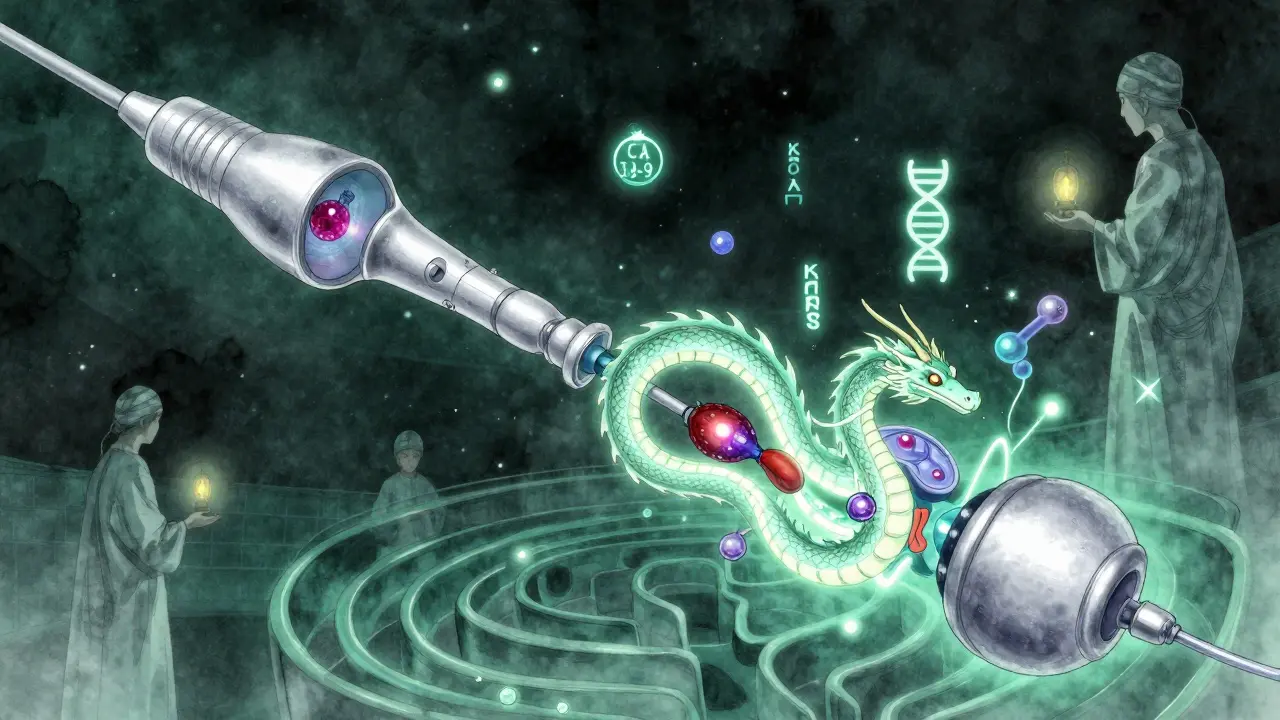
Treatment Advances That Are Saving Lives
The only real chance for a cure is surgery - removing the tumor before it spreads. The Whipple procedure, first developed in 1935, is still the most common operation. It removes the head of the pancreas, part of the small intestine, the gallbladder, and sometimes part of the stomach. In early-stage cases, 20-25% of patients survive five years after surgery. But surgery isn’t always the first step anymore. That’s where neoadjuvant therapy comes in. This means giving chemotherapy before surgery. It shrinks tumors, kills hidden cancer cells, and makes surgery more likely to succeed. The FOLFIRINOX regimen - a mix of four drugs - has become the go-to. In the 2021 Alliance A021501 trial, 58% of borderline resectable tumors shrank enough to be removed surgically after FOLFIRINOX. For those with advanced disease, survival has doubled in the last decade. In 2000, the median survival was six months. Today, it’s 12 to 15 months. The PRODIGE 24 trial in 2022 showed that patients on modified FOLFIRINOX lived a median of 54.4 months - nearly four and a half years - compared to 20.2 months with older treatments. And now we’re seeing the rise of targeted therapies. Not everyone qualifies, but for those who do, the results are dramatic:- If you have a BRCA1 or BRCA2 mutation (about 5-10% of pancreatic cancers), olaparib - a PARP inhibitor - can delay progression by 7.4 months after chemotherapy, based on the 2019 POLO trial.
- If your tumor has MSI-H or dMMR (only 3-4% of cases), pembrolizumab, a checkpoint inhibitor, has shown a 40% response rate.
These aren’t cures - but they’re turning what was once a death sentence into a manageable chronic condition for some.
The Future Is in Early Detection
The biggest breakthroughs aren’t in surgery or chemo - they’re in finding cancer before symptoms appear. Researchers are betting big on liquid biopsies. These are simple blood tests that look for cancer DNA, proteins, or other markers. The PancreaSeq test from Johns Hopkins, launched in 2023, detects mutant KRAS DNA in blood samples with 95% accuracy in high-risk people. The DETECTA trial is testing a blood test that looks at protein patterns and tumor DNA. In early results, it correctly identified pancreatic cancer in 85% of cases. Even AI is getting involved. Google Health’s LYNA algorithm, trained on thousands of tissue slides, can spot pancreatic cancer in pathology images with 99.3% accuracy - better than many human pathologists. And then there’s the microbiome. A 2023 study in Cell Reports Medicine found that people with pancreatic cancer have distinct gut bacteria patterns. A simple stool test could one day screen for cancer - no blood draw needed. The National Cancer Institute’s 2023 plan aims to cut pancreatic cancer deaths by 25% by 2030. That’s ambitious - but with these tools, it’s within reach.What You Can Do Now
If you’re over 50 and have unexplained weight loss, new diabetes, or persistent pain - don’t wait. Ask your doctor about an ultrasound or CT scan. If you have a family history of pancreatic, breast, or ovarian cancer, ask about genetic testing. BRCA mutations aren’t just a breast cancer risk - they’re a pancreatic cancer risk too. If you’ve been told you have “gallstones” or “IBS” but your symptoms don’t improve - get a second opinion. A 2022 Reddit analysis of 350 patient posts found that 72% were misdiagnosed at first. Pancreatic cancer is often mistaken for common digestive issues. And if you’re worried about depression or anxiety that came out of nowhere - consider it a red flag. Mental health changes can be the body’s first signal. The truth is, pancreatic cancer is still dangerous. But it’s no longer a silent killer with no hope. We’re learning how to listen to the body’s quiet warnings. We’re using better tools. We’re treating it smarter. And for the first time, survival isn’t just a statistic - it’s a possibility.Can pancreatic cancer be detected before symptoms appear?
Yes - but only for people at high risk. Those with inherited gene mutations like BRCA1/2, hereditary pancreatitis, or a strong family history can undergo regular screening with endoscopic ultrasound and MRI. For the general population, there’s no proven screening test yet. However, new blood tests like PancreaSeq and DETECTA are showing promise in early trials and may become available for broader use in the next few years.
Is jaundice always a sign of pancreatic cancer?
No. Jaundice can be caused by many things - hepatitis, gallstones, or liver disease. But when jaundice appears with unexplained weight loss, new-onset diabetes, or abdominal pain, it’s a major red flag for pancreatic cancer. In fact, about 70% of pancreatic head tumors cause jaundice because they block the bile duct. If it comes on suddenly and without a clear cause, it should be investigated.
Why is pancreatic cancer so deadly?
It’s deadly because it grows silently and spreads early. The pancreas is deep in the body, so tumors don’t cause pain until they’re large or pressing on nerves. By the time symptoms appear, the cancer has often already spread to nearby organs or the liver. Also, there’s no routine screening test for the general public. Only 12% of cases are caught early enough for surgery - and even then, survival rates are still low. The combination of late detection and aggressive biology makes it one of the deadliest cancers.
Can lifestyle changes prevent pancreatic cancer?
You can’t prevent it entirely, but you can lower your risk. Smoking is the biggest preventable cause - it doubles the risk. Obesity, heavy alcohol use, and chronic pancreatitis also increase risk. Eating a healthy diet, staying active, and avoiding tobacco can help. For people with inherited risks, genetic counseling and regular monitoring are the best tools for prevention.
What’s the survival rate for pancreatic cancer today?
The overall 5-year survival rate is about 12%, according to the National Cancer Institute. But that number hides a huge difference based on stage. If the cancer is caught before it spreads (localized), the 5-year survival jumps to 44%. If it’s spread to distant organs, it drops to 3%. New treatments like FOLFIRINOX and targeted therapies are pushing survival times longer - especially for those who respond well. Some patients with metastatic disease now live 4 to 5 years.
Nerina Devi
February 26, 2026 AT 04:11It’s heartbreaking how often these quiet symptoms get ignored-especially in cultures where ‘just push through’ is the norm. I’ve seen my aunt brush off weight loss and fatigue for months because ‘she’s just getting older.’ By the time they tested, it was stage IV. We need more awareness, not just in the US but everywhere. This post? It’s a lifeline for so many.
Dinesh Dawn
February 26, 2026 AT 12:11Man, I didn’t realize new-onset diabetes could be a red flag like that. My uncle was diagnosed last year-no symptoms, just a routine blood test. Turns out, his glucose had been creeping up for a year. He’s doing okay now thanks to early detection. Thanks for laying this out so clearly.
Vanessa Drummond
February 28, 2026 AT 02:42Okay but let’s be real-why is the medical system still acting like pancreatic cancer is some mysterious ghost? We have AI that can recognize cats in photos, but we can’t screen for a cancer that kills 90% of people within a year? This isn’t ‘just rare’-it’s negligence wrapped in bureaucracy.
Nick Hamby
March 2, 2026 AT 01:27There’s a profound irony here: the very organ responsible for regulating our metabolic equilibrium is also one of the most lethal when it fails silently. The advances in neoadjuvant therapy and targeted agents like olaparib represent not merely clinical progress, but a philosophical shift-from reactive medicine to anticipatory care. We are learning to listen to the body’s whisper before it becomes a scream. And yet, access remains inequitable. The real challenge isn’t scientific-it’s ethical. Who gets to benefit from these breakthroughs? And who remains unseen by the system?
kirti juneja
March 2, 2026 AT 16:41OMG this is wild-gut bacteria could be our next early warning system?! Like, imagine a simple poop test telling you ‘hey, something’s off in there.’ I’m all for this. My cousin got diagnosed because she kept getting weird stomach issues and her doctor called it ‘stress.’ Turns out, her microbiome was screaming. We need more of this kind of science-no more brushing off weird symptoms. Let’s get weird with our health!
Haley Gumm
March 2, 2026 AT 22:03Let’s not pretend FOLFIRINOX is a miracle cure. It’s brutal. My mom lost 30 pounds, couldn’t taste food, and still got metastases. The stats look good on paper, but real people? They’re just trying to survive the treatment. Also-AI detecting cancer? Cool. But who’s gonna pay for it when your insurance says ‘not medically necessary’?
Gabrielle Conroy
March 3, 2026 AT 22:50This is so important!!! 💖🙌 I’m so glad someone finally broke this down without sugarcoating it. I had no idea about the depression link-my sister had it for 8 months before her diagnosis, and everyone just thought she was ‘going through a phase.’ And the microbiome thing?! 🤯🤯 I’m sharing this with my whole family. Also, if you’re over 50 and have unexplained weight loss? GO GET CHECKED. Like, TODAY. Seriously. 😭🩺
Spenser Bickett
March 5, 2026 AT 10:00Wow. So the answer to cancer is… more blood tests? More scans? More money? News flash: we’re all gonna die. Maybe we should stop throwing billions at late-stage chemo and start asking why we’re all so sick in the first place. Also, ‘pancreasseq’? Sounds like a startup that got funding because someone said ‘blockchain’ too many times. 🤡