


When your body can’t use sugar for energy, it starts burning fat instead. That sounds harmless-until your blood turns acidic. That’s diabetic ketoacidosis, or DKA, and it doesn’t wait for permission. It hits fast, often when you least expect it, and it can kill within hours if ignored.
Most people think DKA only happens to those with type 1 diabetes. But it can also strike people with type 2 who’ve stopped insulin, gotten seriously ill, or are taking newer medications like SGLT2 inhibitors. In fact, about 1 in 10 DKA cases happen with blood sugar levels below 250 mg/dL-what doctors now call euglycemic DKA. If you’re diabetic and feeling off, don’t wait for your glucose meter to scream red. Listen to your body.
What DKA Feels Like: The Warning Signs You Can’t Ignore
DKA doesn’t start with a bang. It creeps in over hours. At first, you might think you’re just dehydrated or coming down with the flu. But the signs are specific-and they build.
Early on, you’ll feel thirsty enough to drink a full liter of water every hour. You’re peeing constantly-sometimes more than 3 liters a day. Your mouth feels like sandpaper. These aren’t just inconveniences. They’re your body screaming that insulin isn’t working. Blood sugar is climbing, but your cells are starving.
By 12 to 24 hours in, nausea and vomiting kick in. About 75% of people with DKA can’t keep food or water down. Abdominal pain hits half of them-sharp, crampy, and often mistaken for appendicitis or food poisoning. Fatigue isn’t just being tired. It’s collapsing on the couch after walking to the bathroom. Grip strength drops by 30-40%. You can’t hold a coffee cup.
Then comes the breath. A sweet, fruity smell-like nail polish remover or overripe apples. Clinicians notice it before patients do. It’s acetone, the ketone your body dumps out. Your breathing changes too. Deep, fast, labored breaths-called Kussmaul respirations. Your lungs are trying to blow off acid. That’s your body’s last-ditch effort to survive.
If you’re confused, disoriented, or can’t think clearly, it’s already critical. At this point, your blood pH is below 7.1. You might not even realize how bad it is. That’s why family members often call 911. One in seven people with DKA end up in the ICU because they waited too long.
How Doctors Diagnose DKA in the Emergency Room
It’s not just about blood sugar. A glucose reading of 300 mg/dL doesn’t mean DKA. You could just be sick and stressed. DKA requires three things: high blood sugar, ketones in your blood, and acid in your blood.
Doctors check your blood glucose-usually above 250 mg/dL, but sometimes lower. Then they test for ketones. Not urine strips. Blood ketone meters, like the Precision Xtra or Nova StatStrip. A reading over 3 mmol/L confirms dangerous ketosis. Finally, they take an arterial blood gas. If your pH is below 7.3 and your bicarbonate is under 18 mmol/L, you’re in DKA.
Many ERs now use point-of-care ketone testing for any diabetic patient with blood sugar over 250 mg/dL. Before this, 18% of DKA cases were missed-often diagnosed as gastroenteritis. One study found that when ER staff started using ketone tests routinely, missed DKA cases dropped by 37%.
And don’t assume you’re safe just because you’re on an insulin pump. About 35% of pump-related DKA cases happen because the infusion set clogged during illness. Your body needs more insulin when you’re sick-but the pump can’t deliver it if the tube is blocked.
What Happens in the Hospital: The Treatment Protocol
DKA isn’t treated with a pill. It’s treated like a medical emergency-and it should be. Every minute counts.
First, fluids. You’re severely dehydrated. Doctors give you 1 to 1.5 liters of saline in the first hour. That’s about 20 to 30 minutes of IV drip. Then they slow it to 250-500 mL per hour. Why so fast? Dehydration makes your blood thick, your kidneys sluggish, and your insulin less effective. Rehydrating is step one.
Next, insulin. Not a shot. Not a pump. A continuous IV drip. A small bolus of 0.1 units per kilogram of body weight, then a steady drip at the same rate. The goal? Lower your blood sugar by 50 to 75 mg/dL per hour. Too fast? You risk brain swelling-especially in kids. That’s the leading cause of death in pediatric DKA.
Then, potassium. This is where many mistakes happen. Your blood potassium might look normal. But your body is completely drained. Insulin drives potassium into cells. If you don’t replace it, your heart can stop. Doctors start potassium replacement as soon as your level drops below 5.2 mmol/L. Most patients need 20-30 mEq per hour.
Bicarbonate? Rarely. Only if your pH is below 6.9. Giving it too early can make things worse. Less than 5% of DKA patients need it. Yet 22% of U.S. hospitals still use outdated protocols that overuse it.
They’re also looking for the trigger. Half the time, it’s an infection-pneumonia, UTI, or a simple cold. Thirty percent of cases are from skipped insulin. Twenty percent? New-onset diabetes. That’s why kids with vomiting and weight loss need a full diabetes workup-even if they’ve never been diagnosed before.
How Long Do You Stay in the Hospital?
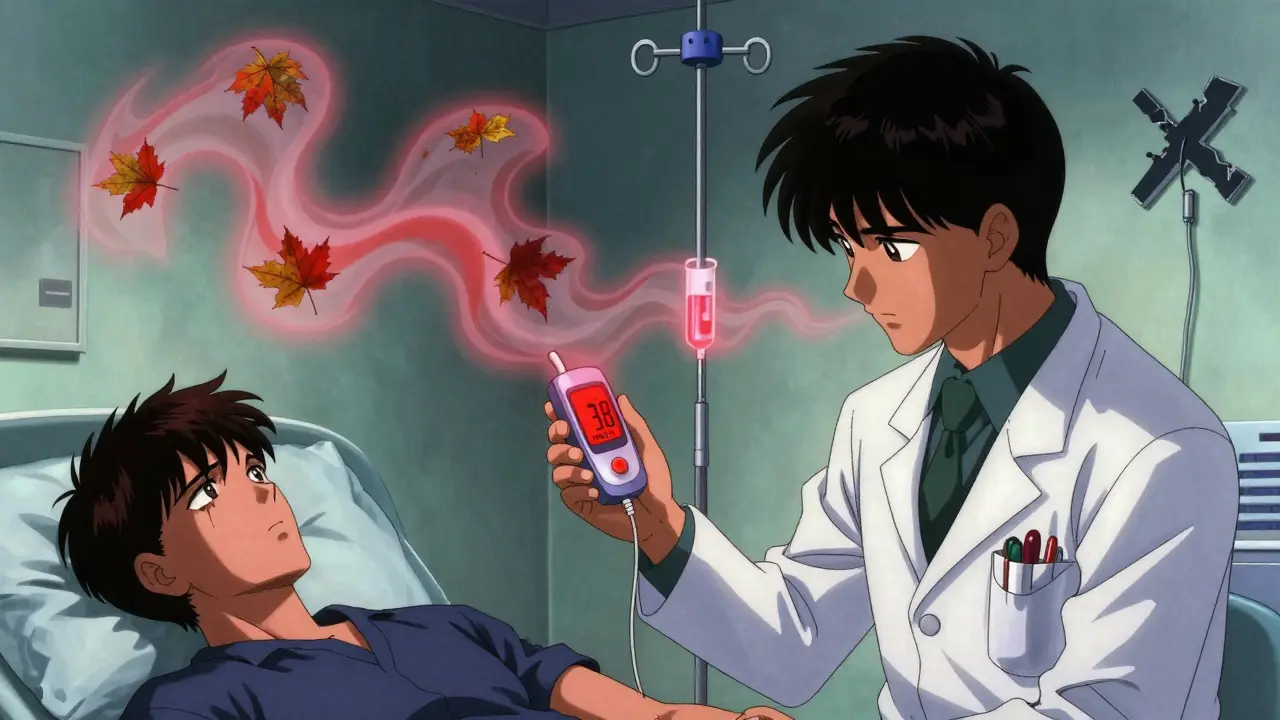
It’s not a one-night stay. Most people are in for 2.5 to 4 days. But it depends on how bad it was. If your pH was 7.0-7.2, you might leave in 2 days. If it was below 7.0, expect 4 or more.
Doctors won’t discharge you until three things are stable: your blood ketones are below 0.6 mmol/L, your bicarbonate is above 18 mmol/L, and your pH is back over 7.3-on two consecutive checks. If you’re discharged too early, 12% of people relapse within 72 hours.
And you won’t leave without a plan. You’ll get education on insulin dosing during illness, how to test ketones at home, and when to go back to the ER. If you’re on an insulin pump, you’ll be told to switch to injections when you’re sick. If you’re on SGLT2 inhibitors, you might need to stop them during illness.
What You Can Do to Prevent DKA
DKA isn’t random. It’s preventable-if you know what to look for.
Use your CGM. People with continuous glucose monitors reduce DKA by 76%. Why? Because they get alerts when glucose spikes and ketones rise. One study found 92% of users acted on those alerts before symptoms got bad.
Check ketones when your blood sugar is over 240 mg/dL. Do it every 4-6 hours if you’re sick. If you see moderate or large ketones, call your doctor or go to the ER. Don’t wait for vomiting. Don’t wait for confusion.
Never skip insulin-even if you’re not eating. Your body still needs it. If you can’t afford insulin, talk to your doctor. There are patient assistance programs. One in three DKA cases in the U.S. is tied to insulin rationing. That’s not just tragic-it’s preventable.
If you’re newly diagnosed, get educated fast. About 30% of pediatric DKA cases are the first sign of type 1 diabetes. Parents often think it’s the flu. Doctors miss it. If your child has unexplained weight loss, extreme thirst, or bedwetting after being potty-trained, test for ketones.
And if you’re in a low-resource setting, know this: subcutaneous insulin (injected under the skin) works. WHO has shown it cuts mortality from 15% to 6% in places where IV access is hard to get. You don’t need a hospital bed to save a life-you need knowledge and timely action.
Why DKA Is Still Rising
Despite better technology and guidelines, DKA cases are going up-by 5.3% every year in the U.S. Why? Because healthcare isn’t equal.
Uninsured patients are 3.2 times more likely to get DKA than those with insurance. Cost barriers delay care. People wait until they’re collapsing before they go to the ER. And when they do, they’re more likely to be misdiagnosed.
New tools are coming. A prediction algorithm called DiaMonTech’s DKA Risk Score can warn patients 12 hours before DKA hits-by analyzing CGM trends. It’s already being built into systems like Tidepool Loop. But tech won’t help if people can’t afford the devices.
DKA isn’t just a medical condition. It’s a symptom of a broken system. And until we fix access to insulin, education, and emergency care, it will keep killing people who didn’t have to die.
Can you have DKA with normal blood sugar?
Yes. This is called euglycemic DKA and accounts for about 10% of cases. It’s most common in people taking SGLT2 inhibitors (like Farxiga or Jardiance) or in those with type 1 diabetes who’ve reduced insulin but still have some residual production. Blood sugar may be below 250 mg/dL, but ketones and acid levels are dangerously high. Always test ketones if you feel sick, even if your glucose seems normal.
Is DKA only for people with type 1 diabetes?
No. While 80% of cases occur in type 1 diabetes, DKA can also happen in type 2 diabetes-especially during severe illness, infection, or when insulin therapy is stopped. People on SGLT2 inhibitors are at higher risk, even if they’ve never needed insulin before. Any diabetic with insulin deficiency can develop DKA.
How do I know if I should go to the ER for DKA?
Go to the ER if you have two or more of these: blood sugar over 250 mg/dL, vomiting, abdominal pain, fruity breath, deep rapid breathing, or confusion. Even if you’re not sure, test your blood ketones. If they’re moderate or high, don’t wait. Call 911 or go immediately. Delaying treatment increases mortality by 15% per hour after the first two hours.
Can I treat DKA at home with extra insulin?
No. DKA requires hospital-level care. Home insulin doses can’t replace the precise IV fluids, electrolyte monitoring, and continuous insulin infusion needed to safely reverse acidosis. Attempting to treat it at home risks brain swelling, heart arrhythmias, or death. If ketones are present and you’re symptomatic, seek emergency care.
Why do I need potassium if my blood test shows normal levels?
In DKA, your total body potassium is severely low-even if your blood test looks normal. Insulin drives potassium into cells, and acidosis pushes it out of cells into the blood. When you start insulin treatment, potassium drops rapidly. Without replacement, you can develop dangerous heart rhythms or muscle paralysis. Doctors start potassium replacement as soon as levels fall below 5.2 mmol/L, even if they started normal.
How can I prevent DKA if I use an insulin pump?
Switch to insulin injections during illness or if you’re sick. About 35% of pump-related DKA cases happen because the infusion set clogged or disconnected. Check your site every 4-6 hours. If your glucose rises unexpectedly, test for ketones. Don’t assume your pump is working just because it’s beeping. Always have backup insulin and syringes on hand.
Can children get DKA without being diagnosed with diabetes?
Yes. About 30% of DKA cases in children are the first sign of type 1 diabetes. Parents often mistake symptoms like vomiting, fatigue, and increased thirst for a stomach bug. If your child has unexplained weight loss, frequent urination, or bedwetting after being dry for months, get them tested. Early detection saves lives.
What Comes After Hospital Discharge
Getting out of the hospital isn’t the end. It’s the beginning of a new routine.
You’ll need follow-up with an endocrinologist within a week. They’ll adjust your insulin doses, review your pump settings (if applicable), and check for underlying triggers. If you’re on SGLT2 inhibitors, they’ll likely stop them and switch you to a safer regimen.
Education is key. Most hospitals offer diabetes self-management training. Learn how to adjust insulin during illness. Know your ketone testing schedule. Understand when to call your doctor versus when to go to the ER.
And if cost is a barrier-say something. Insulin costs $374 a month on average in the U.S. Many people ration. That’s not just dangerous-it’s deadly. Ask about patient assistance programs, generic insulin, or state-funded aid. Your life is worth more than the price tag.
DKA isn’t a failure. It’s a warning. And if you’ve survived it, you now have the knowledge to prevent it next time. Use it.
Madhav Malhotra
January 11, 2026 AT 14:17Man, this hit different coming from India where insulin access is still a real struggle. I saw my uncle nearly lose it last year because he skipped doses to save money. No one should have to choose between eating and staying alive. Thanks for laying this out so clear.
Alex Smith
January 13, 2026 AT 07:45So let me get this straight - we’ve got AI that can predict when your toaster will burn toast, but people are still dying because they can’t afford insulin? 🤦♂️ And we call this a healthcare system? At this point, DKA isn’t a medical emergency - it’s a policy failure with symptoms.
Roshan Joy
January 14, 2026 AT 05:33Big shoutout to the part about euglycemic DKA - I didn’t know that was a thing until my cousin got hospitalized with normal sugars but crazy ketones. She was on Jardiance and thought she was fine. Never again. Always check ketones if you feel off, even if your CGM says ‘green’.
Adewumi Gbotemi
January 16, 2026 AT 03:21This is important. In Nigeria, many people think diabetes is just sugar problem. They don’t know about keto. My brother got sick and we took him to the clinic but they gave him painkiller. He almost died. Now I tell everyone: if you’re diabetic and sick, test for ketones. No excuses.
Vincent Clarizio
January 17, 2026 AT 16:34Let’s be real - the entire narrative around DKA is built on a foundation of capitalist neglect disguised as medical science. The fact that we’re still debating whether to give bicarbonate in 2024 while insulin costs more than a PlayStation is not a medical issue - it’s a moral indictment of Western civilization. We’ve optimized for profit margins and outsourced empathy to charity fundraisers. The IV drip is just a Band-Aid on a hemorrhaging system. Your CGM alerts are cute, but they don’t pay your rent. And if you think tech will fix this, you haven’t met the 30% of Americans who ration insulin because their deductible is higher than their monthly salary. We’re not treating disease here - we’re managing the consequences of a broken economy that treats human life like a line item.
Jennifer Littler
January 17, 2026 AT 20:40Regarding potassium replacement: the literature consistently shows that hypokalemia in DKA is a total body deficit masked by transcellular shifts. The serum potassium concentration is an unreliable marker during acidosis, and insulin administration exacerbates the intracellular shift - hence the necessity for aggressive replacement even when labs appear normal. Failure to do so increases the risk of fatal arrhythmias, particularly torsades de pointes. Protocols from the American Diabetes Association and the International Society for Pediatric and Adolescent Diabetes both emphasize this. Still, many ERs lag behind.
Sean Feng
January 18, 2026 AT 22:52So you’re telling me if I’m sick and my sugar is 200 I should go to the ER? Ok. Got it. Next.
Priscilla Kraft
January 18, 2026 AT 23:03Thank you for mentioning SGLT2 inhibitors - I’m on Farxiga and didn’t realize the risk until now. I’m switching to injections if I get sick. Also, the part about kids? My niece had vomiting and weight loss and we thought it was a virus. She was diagnosed with T1D after DKA. This post saved lives. 🙏
Christian Basel
January 20, 2026 AT 08:48DKA treatment protocols are outdated. IV fluids at 1-1.5L/hr? That’s not evidence-based - it’s tradition. The 2022 ISPAD guidelines recommend isotonic saline at 10-20 mL/kg/hr, not 1L/hr for adults. And why are we still using arterial blood gases instead of venous? Venous pH correlates within 0.05 units. Saves time. Saves money. Saves needles. This is 2024, not 1994.
Michael Patterson
January 21, 2026 AT 09:31Why do people keep saying DKA is preventable? Like it’s just a matter of trying harder? I know people who test ketones daily, take insulin on time, eat right - and still get it because their pump got clogged or their insurance denied a new sensor. You don’t get to blame the patient when the system is rigged. And don’t even get me started on the fact that most of these ‘education programs’ are 10 minute videos with a 1200 word PDF no one reads. This isn’t empowerment - it’s guilt-tripping with a stethoscope.
Matthew Miller
January 22, 2026 AT 18:08Stop glorifying this as some heroic medical battle. DKA is the result of lazy patients who don’t read their meds, lazy doctors who don’t follow up, and lazy insurers who won’t cover CGMs. You think this is about access? It’s about accountability. If you can’t manage your diabetes, don’t act surprised when you end up in the ICU. This isn’t a tragedy - it’s a pattern.