


Every day, pharmacists face a quiet but relentless battle: patients showing up with a prescription for a brand-name drug, only to find out their insurance won’t cover it unless they first try a cheaper generic. This isn’t a rare hiccup-it’s the new normal. In 2024, generic alternatives are at the center of nearly two-thirds of all prior authorization requests in U.S. pharmacies. And while the goal is to save money, the system often slows down care instead.
What Exactly Is Prior Authorization for Generic Alternatives?
Prior authorization isn’t a new idea, but its use for generics has exploded. It’s when your insurance company demands proof that a cheaper, FDA-approved generic version won’t work before they’ll pay for the more expensive brand-name drug. This isn’t about safety-it’s about cost control. The Centers for Medicare & Medicaid Services (CMS) formalized these rules back in 2010, and since then, 97% of commercial insurers and 100% of Medicaid managed care plans have adopted them.
Here’s how it usually plays out: A doctor prescribes a brand-name medication for high blood pressure. The pharmacy’s system flags it: “Generic available. Prior auth required.” The pharmacist calls the doctor’s office. The provider must now submit clinical documentation-patient history, lab results, failed trials of generics-to the insurer. If the insurer says no, the patient either pays out of pocket, waits, or skips the medication entirely.
The Seven-Step Process Pharmacists Deal With Daily
It’s not just a form. It’s a seven-step maze:
- Identify the need: The pharmacy’s system detects a brand-name drug with an available generic equivalent. This happens in seconds.
- Prepare clinical documentation: The provider must show why the generic failed. Not just “didn’t work”-they need specifics: “Patient took 10 mg of lisinopril daily for 6 weeks; BP still averaged 152/94.”
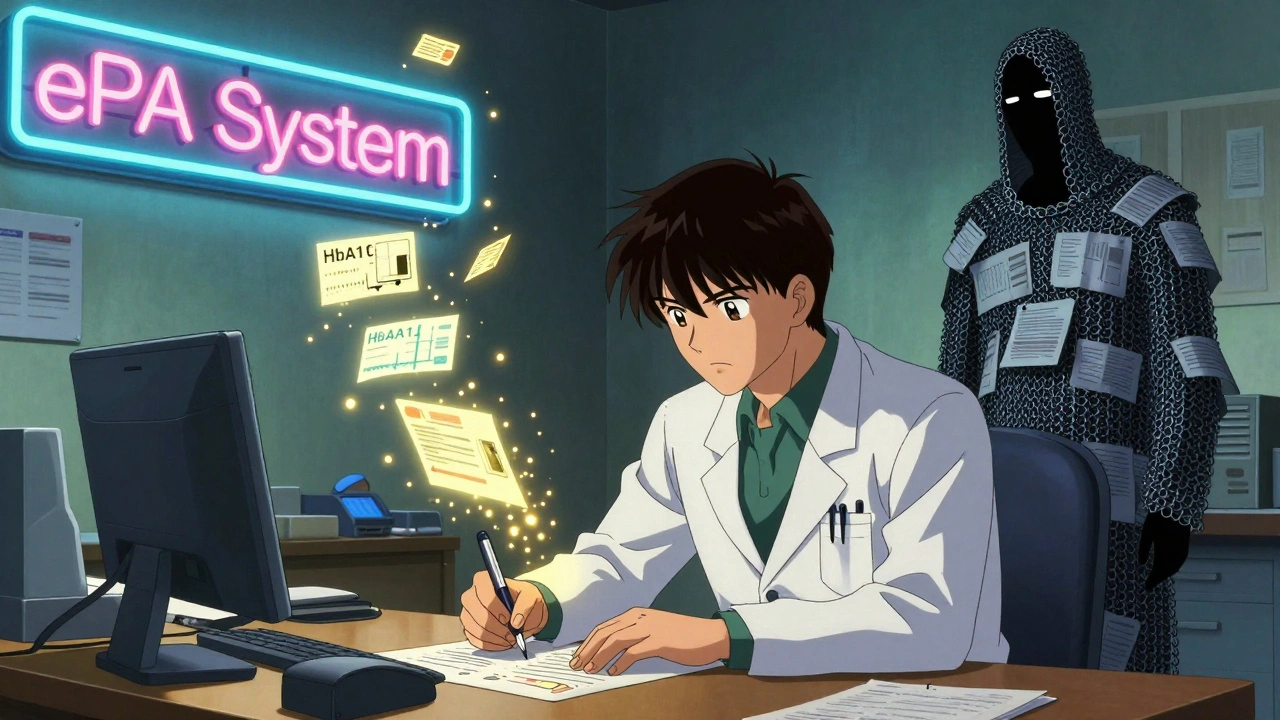
- Submit the request: Most now use electronic prior authorization (ePA). But 1 in 5 still rely on fax or phone, which delays things.
- Payer review: A clinical pharmacist or medical director reviews the case against payer-specific rules. Some require two failed generics. Others demand documented HbA1c levels or symptom logs.
- Decision: Approval, denial, or request for more info. Timelines vary: Cigna says 5-10 business days. UnitedHealthcare says 7-14 calendar days. Starting January 1, 2026, Medicaid must respond in 7 days for standard requests.
- Notification: The pharmacy gets the result. If denied, the patient is left waiting.
- Appeal: If the patient’s condition is worsening, providers can appeal. But only 18% of appeals succeed without new data.
That’s a lot for one prescription. And it’s not just one per day. The average primary care provider submits 43 prior authorizations weekly. About 68% of those involve generic alternatives.
Why Do Insurers Make This So Hard?
It’s not just about saving money-it’s about controlling usage. Insurers use something called “step therapy.” That means patients must try and fail on lower-cost drugs before moving up. For diabetes, UnitedHealthcare requires a 30-day trial of two different generics before approving a brand-name GLP-1 agonist. Aetna? Just 14 days, with an HbA1c reading.
But here’s the problem: Many generics aren’t truly interchangeable in practice. For example, a patient might have tried three different generic versions of sertraline and still had severe anxiety. But insurers don’t always recognize that. A 2023 CMS report found that 17.3% of prior authorization denials for brand-name drugs were medically inappropriate-meaning patients were denied care they actually needed.
And the burden? It’s real. A 2024 JAMA Internal Medicine study found that prior authorizations waste $13.4 billion a year in provider time. Sixty-three percent of that time is spent on generic alternatives. One physician reported spending 14.6 hours a week just filling out forms.
What Works? Real Strategies That Cut Through the Red Tape
Some pharmacies and clinics have figured out how to win this game. Here’s what actually helps:
- Submit 14 days in advance. Don’t wait until the patient’s prescription runs out. Start early. The American Medical Association recommends this as the bare minimum.
- Document failure with numbers. Saying “the generic didn’t work” gets denied. Saying “patient took 20 mg of metformin daily for 8 weeks; HbA1c dropped from 8.9% to 7.6%-still above target of 7.0%” gets approved 87% of the time.
- Use ePA, not fax. Electronic submissions get approved in the same week 78% of the time. Fax? Only 34%.
- Know your gold cards. Some providers have “gold carding”-automatic approval for certain drugs if they’ve had a 95%+ approval rate. But only 29% of eligible providers even know they have it.
- Assign a dedicated staff member. Clinics with a prior authorization coordinator cut processing time by 52%. That’s half the time.
- Use payer templates. Each insurer has its own form. Using the right one cuts denials by 37%.
One success story? The University of Pittsburgh Medical Center automated their workflow. Before: 9.2 days to approve a generic alternative. After: 2.1 days. First-pass approval rate jumped from 58% to 89%.
Where the System Breaks Down-And Who Pays
Patients don’t always know they’re stuck in this loop. They show up, get told the drug isn’t covered, and walk away. A 2024 Patients Rising survey found that 67% of patients abandon treatment after prior authorization delays-especially for mental health and chronic conditions.
And it’s not just patients. Pharmacists are burned out. A 2024 Medscape survey found 43% of physicians would reduce patient volume if prior authorization got any worse. For pharmacists, it’s the same. Every denied request means another phone call, another email, another patient upset.
Even worse: Some insurers still require two failed generics-even when the first one is a generic version of the same drug. For example, a patient tries generic amlodipine, then generic lisinopril, then gets denied for brand-name lisinopril because the first one “didn’t work.” But both generics are chemically identical. That’s not step therapy. That’s bureaucracy.

What’s Changing in 2025 and Beyond
The rules are shifting. The CMS Interoperability and Prior Authorization Proposed Rule, released in May 2024, will require real-time benefit checks by 2026. That means when a doctor prescribes a drug, the system will instantly show: “Generic available. Prior auth needed.” No more surprises at the pharmacy counter.
Also, 38 states have passed laws to limit prior authorization. Texas, for example, now requires a 72-hour turnaround for urgent cases. And by 2027, all major payers must use FHIR-based APIs-standardized digital systems that could cut approval times to under 24 hours for routine cases.
Some are even testing blockchain systems. Mayo Clinic’s pilot lets providers submit exceptions via a distributed ledger. Their approval rate for generic alternatives? 92%.
But the biggest change? AI. Sixty-one percent of large health systems are now testing natural language processing tools that auto-fill prior authorization forms from clinical notes. Early results show a 44% drop in submission time.
What Pharmacists Can Do Today
You don’t have to wait for policy changes to make a difference. Here’s what you can do right now:
- Keep a cheat sheet of payer rules. Know what UnitedHealthcare requires vs. Aetna vs. Medicaid. Post it where your team can see it.
- Build relationships with provider offices. If your local clinic knows you’re the person who handles prior auth, they’ll send you the right info upfront.
- Train your staff on documentation. Teach them to write “failed after 6 weeks at 40 mg” instead of “didn’t work.” Small changes, big results.
- Advocate for patients. If a patient can’t afford the brand-name drug and the generic failed, ask the provider to appeal. Don’t let them give up.
- Track your numbers. How many requests do you submit? How many get denied? Where are the bottlenecks? Data tells you where to focus.
This isn’t just about filling prescriptions. It’s about making sure patients get the right medicine, on time. The system is broken-but it’s not hopeless. With better documentation, smarter tools, and a little persistence, pharmacists can turn prior authorization from a headache into a manageable part of care.
Why do insurers require prior authorization for generic alternatives?
Insurers require prior authorization for generic alternatives to control costs by enforcing step therapy-making patients try cheaper, FDA-approved generics first before covering more expensive brand-name drugs. While the goal is to reduce spending, many of these policies lack clinical nuance and can delay necessary treatment.
How long does prior authorization for generics typically take?
Processing times vary by insurer. Cigna takes 5-10 business days, UnitedHealthcare 7-14 calendar days. Starting January 1, 2026, Medicaid plans must respond within 7 calendar days for standard requests and 72 hours for urgent cases. Electronic submissions often get same-day or same-week responses.
What documentation is needed to get prior authorization approved?
You need specific, measurable proof that the generic failed. Vague statements like “didn’t work” get denied. Approved requests include details like: “Patient took 20 mg of metformin daily for 8 weeks; HbA1c dropped from 8.9% to 7.6%-still above target of 7.0%.” Documenting symptom reduction, lab values, or duration of trial increases approval rates by up to 87%.
Can pharmacists submit prior authorization requests?
Pharmacists cannot submit prior authorization requests-only licensed prescribers (doctors, nurse practitioners, PAs) can. But pharmacists play a critical role in identifying when prior auth is needed, helping providers gather the right documentation, and following up with insurers to speed up the process.
What is ‘gold carding’ and how does it help?
Gold carding is when a provider gets automatic approval for certain medications because they have a 95%+ approval rate over time. This eliminates prior auth for those drugs. However, only 29% of eligible providers know they have this status. Pharmacists can help by tracking which providers have high approval rates and encouraging them to check with their payers.
Are there laws limiting prior authorization for generics?
Yes. As of September 2024, 38 states have passed prior authorization reform laws, and 27 of them specifically target generic alternatives. Texas, for example, requires a 72-hour turnaround for urgent cases. Federal rules under CMS will require 7-day decision timelines for Medicaid starting in 2026.
Why do so many prior authorization requests get denied?
The most common reason is inadequate documentation-63% of initial denials happen because the provider didn’t clearly show how the generic failed. Other reasons include using the wrong form, submitting late, or missing required codes (like ICD-10 or CPT). Electronic submissions and payer-specific templates reduce denials significantly.
What’s the future of prior authorization for generics?
The future is digital and faster. By 2027, all major payers must use FHIR-based APIs, which could cut approval times to under 24 hours. AI tools are already auto-filling forms, and blockchain pilots are improving accuracy. Real-time benefit checks at the point of prescribing will reduce surprises. The goal is to remove administrative friction while keeping cost controls.
Martyn Stuart
December 4, 2025 AT 13:36Every time I see a prior auth request for a generic, I think: this isn't healthcare-it's a bureaucratic obstacle course designed by someone who's never held a patient's hand while they cried over a $400 pill. The system doesn't care if the patient's BP is still 160/95 after six weeks of lisinopril-it just wants the form signed, stamped, and faxed. And don't get me started on the fax machines.
Pharmacists are the unsung heroes here. They're the ones calling providers at 7 a.m., chasing down lab results, and explaining to angry patients why their meds are stuck in limbo. Meanwhile, the insurers? They're counting pennies while the patient's diabetes spirals.
I've seen this first-hand: a 72-year-old woman with heart failure, on three generics of the same class, all failed-yet the insurer demanded a fourth. She skipped doses. Ended up in the ER. The prior auth was approved three days later. Too late.
Gold carding? Most providers don't even know they qualify. That's a scandal. And AI auto-filling forms? Long overdue. But until we fix the incentives-until insurers pay for outcomes, not paperwork-we're just rearranging deck chairs on the Titanic.
Stop treating pharmacists like clerks. They're clinical gatekeepers. Train them. Empower them. Pay them for the mental labor they're doing. This isn't just inefficient-it's unethical.
John Filby
December 5, 2025 AT 14:03Just had a patient walk out because her SSRI generic got denied. She said, 'I'm tired of fighting for my meds.' That hit hard. I'm not even a pharmacist, but I've watched my mom go through this for years with her thyroid med. The system is broken. I wish more people understood how much time this steals from doctors and patients alike.
zac grant
December 6, 2025 AT 01:09From a clinical operations standpoint, the real win here is workflow standardization. Implementing a dedicated prior auth coordinator role drops turnaround time by over 50%-that’s not anecdotal, that’s peer-reviewed in JAMIA. The key is embedding the role into the care team, not treating it as an afterthought. Also, leveraging FHIR-based EHR integrations reduces form errors by 68%. Most clinics still use static PDF templates from 2018. That’s like using a rotary phone to call 911.
Pro tip: Use payer-specific templates. UnitedHealthcare’s form requires ICD-10 codes for both the primary diagnosis and the failed generic. Miss one? Denied. Aetna? Needs the exact milligram dosage and duration. Documenting ‘failed after 8 weeks at 40 mg’ isn’t just better-it’s mandatory for approval.
And yes, AI is coming. We’re piloting an NLP model that auto-extracts HbA1c, BP trends, and symptom logs from EHR notes. Cut submission time from 22 minutes to 12. That’s 10 hours a week saved per provider. That’s time you can spend with patients, not paperwork.
Emmanuel Peter
December 7, 2025 AT 18:02Let’s be real-this isn’t about cost control. It’s about profit. Insurers make billions off brand-name drugs through rebates and kickbacks. They don’t care if the patient dies waiting. They just want the pharmacy to bill the brand, then get a rebate back. That’s why they make the process so damn hard. If generics were truly cheaper, why do they require TWO failed attempts? Why do they demand HbA1c logs for a blood pressure med? It’s not clinical-it’s corporate greed dressed up as policy.
And don’t tell me ‘step therapy’ is evidence-based. A 2023 JAMA study showed 17% of denials were medically inappropriate. That’s not policy. That’s malpractice by spreadsheet.
Pharmacists? They’re the only ones left trying to keep patients alive. Meanwhile, the CEOs are on vacation in the Caymans, sipping martinis, laughing at how easy it is to extract money from sick people.
Ashley Elliott
December 8, 2025 AT 01:13I’ve been a pharmacy tech for 11 years. I’ve seen the same stories over and over. Patient comes in. Prescription flagged. Pharmacist calls doctor. Doctor calls back in 3 days. Patient calls pharmacy. Pharmacy calls insurer. Insurer says ‘more info needed.’ Patient waits. Patient leaves. Patient doesn’t fill. Patient gets worse.
It’s not just about the forms. It’s about the silence. The patient never hears back. The doctor’s office doesn’t follow up. The insurer doesn’t care. And the pharmacist? They’re the one who has to say, ‘I’m sorry, I can’t help you right now.’
Small change: If your clinic has a ‘prior auth tracker’ posted in the back, use it. If you know a provider has gold carding, remind them. If you’re submitting electronically, double-check the ICD code. These things matter.
And yes-it’s exhausting. But we’re still here. Because someone has to be.
Chad Handy
December 8, 2025 AT 12:38I used to work in a pharmacy, and let me tell you, prior auth is the single most soul-crushing part of the job. You’re not just filling prescriptions-you’re playing detective, therapist, and legal advocate all at once. I had a guy come in for his dad’s Parkinson’s med. Generic didn’t work. Brand was $500. Dad had dementia. Couldn’t tell us if the generic made him worse. We spent three weeks calling, faxing, emailing. Got denied twice. Appeal denied. Dad never got the med. Died three months later. Cause of death? Parkinson’s complications. But the insurer? They saved $4,800.
Now I work in IT. I build systems. I’ve coded automated prior auth workflows. I know how this works. And I’m telling you-it’s not broken. It’s designed this way. To hurt people. To make them give up. To let the insurance company win.
They call it ‘cost control.’ I call it cruelty with a spreadsheet.
Joe Lam
December 10, 2025 AT 08:04Look, if you can’t afford the brand-name drug, you shouldn’t be taking it. The system is working exactly as intended. Generics are cheaper, FDA-approved, and clinically equivalent. If your patient ‘didn’t work’ on generics, maybe they’re non-compliant. Maybe they’re lazy. Maybe they’re just looking for the expensive version because they think it’s ‘better.’
Stop romanticizing pharmacists as martyrs. They’re just doing their job. And if your clinic can’t handle a 7-day turnaround, maybe you need better staff. This isn’t a crisis-it’s a consequence of poor practice.
Also, blockchain? AI? Please. We’re talking about a $13 billion administrative cost. That’s less than 0.5% of total U.S. healthcare spending. Fix the real problems-like surgical overutilization or opioid prescribing-before you waste time on this.
Jenny Rogers
December 10, 2025 AT 10:37The ethical imperative here is clear: Prior authorization for generic alternatives is a manifestation of the commodification of human health. When the body becomes a line item on a balance sheet, we have crossed a moral threshold that cannot be undone by technological band-aids such as FHIR APIs or AI form-fillers.
Insurers, as profit-driven entities, are inherently incompatible with the Hippocratic Oath. Their use of step therapy reflects a utilitarian calculus that prioritizes fiscal efficiency over individual dignity. The fact that 67% of patients abandon treatment is not a statistic-it is a moral indictment.
What we require is not procedural optimization, but a fundamental reorientation of healthcare from a market-based paradigm to a rights-based one. Until we recognize access to essential medication as a human right-not a privilege contingent upon bureaucratic approval-we are merely rearranging the furniture in a house on fire.
Bill Wolfe
December 12, 2025 AT 04:01Let me drop some truth bombs: You think this is bad? Wait until you see what happens when you try to get a migraine med approved. I’ve seen people cry because they couldn’t get sumatriptan because they didn’t try three different triptans first-each of which made them vomit for 48 hours. And the insurer says, ‘Try another.’
And don’t even get me started on the ‘two failed generics’ rule for the same drug. It’s like saying, ‘You tried blue Advil, now try red Advil.’ Same molecule. Different color. But the insurer doesn’t care. They have a rule. And rules are sacred.
Meanwhile, the CEO of UnitedHealthcare made $21 million last year. And you’re telling me we can’t fix this? We can. But we won’t. Because the people who benefit from this mess are the ones writing the rules.
AI? Blockchain? Cute. But if you don’t change the incentive structure, you’re just putting glitter on a corpse.
Benjamin Sedler
December 12, 2025 AT 21:15Y’all are acting like this is some new horror story. Nah. This is capitalism with a stethoscope. Insurers aren’t evil-they’re just doing what any corporation does: maximizing shareholder value by offloading costs onto patients, providers, and pharmacists. The only surprise here is that people are shocked.
And the ‘gold carding’ thing? That’s not a solution-it’s a reward for playing the game well. The providers who jump through the most hoops get the least hoops. That’s not justice. That’s a meritocracy of suffering.
Also, ‘document with numbers’? That’s not helpful advice-it’s a trap. Because now you’re not just a pharmacist-you’re a data-entry ninja with a pharmacy degree. Who the hell has time for that? And why should they have to?
This system doesn’t need tweaking. It needs burning down.
Shofner Lehto
December 13, 2025 AT 08:02One of the biggest wins I’ve seen is when clinics start tracking their own denial rates. If your denial rate for lisinopril is 40%, but another provider’s is 8%, guess what? They’re doing something right. Find out what. Copy it. Don’t wait for a national fix. Start local.
Also, if your EHR doesn’t have a prior auth template built in, build one. Use Google Sheets if you have to. Track: who submitted, what insurer, what was denied, what got approved. Patterns emerge. You’ll see which insurers are the worst. Which forms are the most confusing. Which providers are the most responsive.
Knowledge is power. And power is what you need to push back.
Martyn Stuart
December 14, 2025 AT 09:17That’s exactly what I meant. Local action > national policy. I’ve seen a small clinic in rural Ohio cut their approval time from 11 days to 3 just by assigning one person to track every request and calling the insurer’s rep by name every Friday. They even got a rep to give them a direct line.
It’s not glamorous. But it works.