

Medication Swelling Risk Checker
This tool helps you understand your risk of developing medication-related swelling. Based on your medications, age, and health conditions, we'll assess your risk level and provide guidance on what to watch for.
Your Swelling Risk Level
Important warning signs to watch for
- Rapid weight gain (more than 2-3 pounds in 24-48 hours)
- Shortness of breath, especially when lying down
- Swelling in only one leg, especially with pain or redness
- Swelling that doesn't improve overnight
- Swelling with fatigue or rapid heartbeat
Swelling in your ankles, feet, or hands after starting a new medication isn’t always harmless. It’s common - but that doesn’t mean you should ignore it. About 4.4 million Americans each year experience swelling caused by their prescriptions, according to 2022 data from the National Hospital Ambulatory Medical Care Survey. Most of the time, it’s just a side effect. But sometimes, it’s a red flag for something far more serious.
What Causes Medication-Related Swelling?
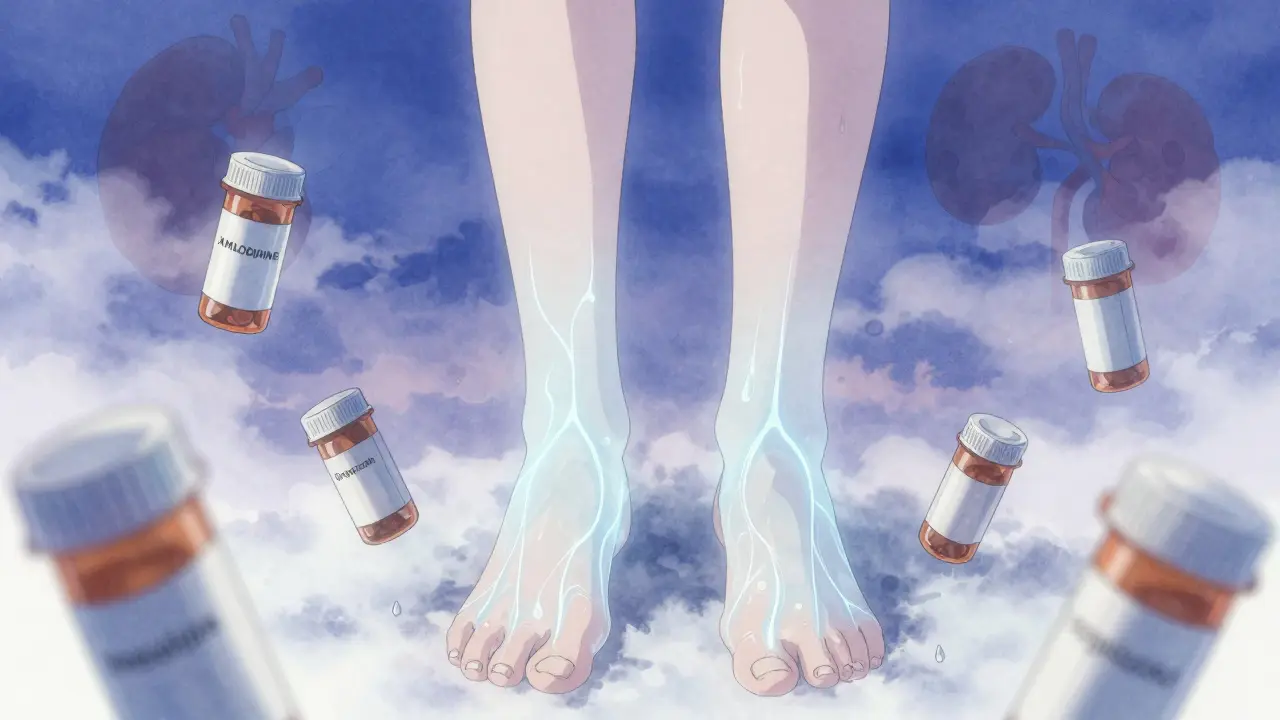
Edema - the medical term for swelling from fluid buildup - happens when tiny blood vessels leak fluid into nearby tissues. It’s not the medicine itself that’s broken. It’s how your body reacts to it. Some drugs make your body hold onto salt and water. Others dilate your blood vessels so much that fluid escapes into your skin and muscles.
Here are the most common offenders:
- Calcium channel blockers like amlodipine (Norvasc): 10-20% of users get swollen ankles. At 10mg daily, that number jumps to 25%. It’s the #1 cause of drug-induced swelling in people with high blood pressure.
- Gabapentin and pregabalin (for nerve pain or seizures): Around 6-8% of users report noticeable swelling, especially in the legs. Patients on higher doses (1,800mg or more) are at greater risk.
- Thiazolidinediones like pioglitazone (Actos) and rosiglitazone (Avandia): These diabetes drugs cause fluid retention in 4-10% of users. Some patients gain 5-10 pounds in weeks - not from eating more, but from water.
- NSAIDs like ibuprofen and naproxen: Even over-the-counter painkillers can cause mild swelling in about 3% of regular users.
- Corticosteroids like prednisone: If you’re on more than 20mg daily for over two weeks, there’s a 20-30% chance you’ll develop swelling. It’s often worse in the face and abdomen.
- Hormonal meds: Birth control pills with 30-35mcg estrogen and hormone replacement therapy can cause mild, temporary swelling in 5-15% of women.
These numbers aren’t guesses. They come from clinical trials, prescribing data, and FDA safety reports. But knowing which drugs cause swelling is only half the battle.
How to Tell If It’s Just a Side Effect - or Something Dangerous
Not all swelling is the same. The difference between a harmless side effect and a life-threatening condition comes down to three things: where it is, how fast it comes on, and what else you’re feeling.
Here’s what to watch for:
- Bilateral swelling (both legs or both ankles) is often linked to medications, heart failure, or kidney problems.
- Unilateral swelling (just one leg) is a red flag for deep vein thrombosis (DVT). If one calf is swollen, warm, red, or painful - get checked immediately. DVT can lead to a pulmonary embolism, which kills 100,000 Americans every year.
- Swelling that doesn’t go down overnight is a sign of lymphedema or chronic disease, not a temporary drug reaction.
- Swelling with shortness of breath - especially when lying flat - suggests fluid in the lungs (pulmonary edema). This is common in heart failure and can be triggered by drugs like pioglitazone.
- Weight gain of more than 2-3 pounds in 24-48 hours means your body is holding onto fluid fast. The NIH says this is a key warning sign.
Dr. Mark Danchenko, a cardiologist at Johns Hopkins, puts it bluntly: “Any new bilateral swelling in someone on amlodipine should make you ask: Is this the drug - or is it heart failure hiding behind it?”
That’s why doctors are trained to look beyond the obvious. Many assume swelling is just from the medication. But in patients over 65, heart and kidney disease are just as likely - if not more so.
When to Call Your Doctor - Not Wait It Out
Here’s a simple checklist. If any of these apply, don’t wait. Call your doctor or go to urgent care:
- You’ve gained more than 5% of your body weight in a month (e.g., 7 pounds if you weigh 140).
- Your swelling is getting worse, not better, after a week.
- You’re short of breath, especially when lying down or walking short distances.
- One leg is swollen, red, hot, or painful - especially if you’ve been sitting for long periods.
- You have swelling in your abdomen (ascites) or around your eyes.
- You’re on pioglitazone, rosiglitazone, or high-dose steroids and notice swelling + fatigue or rapid heartbeat.
One patient on Reddit shared: “My doctor said my pioglitazone swelling was ‘just a side effect.’ I ignored it until I couldn’t breathe. Ended up in the ER with pulmonary edema.” That’s not rare. The FDA recorded over 12,000 edema-related reports for prescription drugs between 2022 and mid-2023 - and that’s just the ones that got reported.

What You Can Do Right Now
If your swelling is mild and your doctor says it’s likely from your meds, you don’t have to just live with it. Here’s what actually works:
- Elevate your legs. Put them above heart level for 15-20 minutes, 4 times a day. Clinical trials show this reduces ankle swelling by 1.5cm in under 48 hours.
- Wear compression socks. 20-30 mmHg pressure stockings cut swelling volume by 30% in a week. They’re not fancy - just medical-grade elastic.
- Lower your sodium. Cut salt to under 2,000mg a day. A 2023 study with 247 patients showed measurable improvement in swelling within 72 hours. Most people eat 3,400mg daily - that’s 70% too much.
- Track your weight daily. Step on the scale at the same time every morning, after using the bathroom. A 2.2-pound (1kg) jump in 24 hours means fluid is building up fast.
One patient on Reddit said: “Compression socks + leg elevation cut my amlodipine swelling by 80%. No new meds needed.” That’s the kind of win you can actually control.
What Your Doctor Might Do Next
If your swelling is serious or persistent, your doctor won’t just say “stop the drug.” They’ll investigate. Here’s what they might check:
- Heart function: An echocardiogram to see if your heart is pumping properly. Swelling + shortness of breath? That’s a red flag for heart failure.
- Kidney function: Blood tests for creatinine and eGFR, plus a urine test for protein. Nephrotic syndrome causes massive swelling and protein loss - it’s easy to miss.
- Liver health: If you have cirrhosis, fluid builds up in your belly and legs. This isn’t drug-related - it’s disease-related.
- Medication switch: For amlodipine, switching to an ARB like losartan often eliminates swelling without losing blood pressure control. For gabapentin, alternatives like duloxetine may work better with less swelling.
- Diuretics: Sometimes doctors prescribe water pills (like furosemide), but they’re not a long-term fix. They don’t fix the cause - they just push fluid out.
According to a 2023 survey of 1,245 physicians, specialists follow edema guidelines 85% of the time. Primary care doctors? Only 65%. That gap can cost lives.
Who’s at Highest Risk?
It’s not just about what you’re taking - it’s who you are.
- People over 75: The American Geriatrics Society lists amlodipine, gabapentin, and pioglitazone as potentially inappropriate for older adults. Why? 40% of patients over 75 develop swelling on these drugs - compared to 15% under 65.
- People with existing heart, kidney, or liver disease: These drugs can make their condition worse. That’s why the FDA requires black box warnings on thiazolidinediones for patients with heart failure.
- People on multiple meds: Polypharmacy is the silent killer. Nearly 28% of adults over 65 take at least one drug that causes swelling. When you add two or three together, the risk multiplies.
Mayo Clinic cut severe edema cases by 22% after adding automated alerts in their electronic records when high-risk drugs were prescribed together. Technology helps - but you have to speak up too.
What’s Changing in 2025?
There’s new hope on the horizon:
- The FDA approved the VascuComp Plus wearable device in March 2023. It uses bioimpedance to detect fluid buildup before you even see swelling - with 92% accuracy.
- New guidelines from the American Heart Association now use blood tests (like BNP levels) and heart scans to tell the difference between drug swelling and heart failure swelling.
- Researchers are testing a lower-dose version of amlodipine with less fluid retention. Results are expected in early 2024.
The market for compression garments is growing fast - up 8.3% last year. Why? Because people are finally realizing: you don’t have to suffer through swelling. There are tools, and they work.
Bottom Line: Don’t Ignore It - But Don’t Panic Either
Swelling from meds is common. But it’s not normal. You deserve to feel safe in your own body. If you notice new swelling after starting a new drug, track it. Note when it happens, how bad it gets, and if anything else changes - breathing, weight, energy.
Don’t assume it’s “just a side effect.” Ask: Could this be my heart? My kidneys? My blood clot?
And if your doctor brushes it off? Get a second opinion. Too many people have been told their swelling is harmless - until it wasn’t.
Is swelling from medication always dangerous?
No, not always. Mild swelling in the ankles after starting amlodipine or gabapentin is common and often harmless. But it can also be the first sign of heart, kidney, or liver problems. The key is to watch for warning signs like rapid weight gain, shortness of breath, or swelling in only one leg - these need immediate attention.
How long does drug-induced swelling last after stopping the medication?
It usually starts to improve within a few days and clears up in 1-3 weeks after stopping the drug. Some people see relief in just 48 hours, especially if they elevate their legs and cut salt. But if swelling doesn’t improve after 2 weeks, there may be another cause - like heart or kidney disease - that needs evaluation.
Can over-the-counter painkillers like ibuprofen cause swelling?
Yes. Regular use of NSAIDs like ibuprofen or naproxen can cause mild fluid retention in about 3% of users. This is more likely if you’re over 60, have high blood pressure, or have kidney issues. It’s not common, but it’s real - and often overlooked.
What’s the best way to reduce swelling from meds at home?
Three proven methods: (1) Elevate your legs above heart level for 15-20 minutes, 4 times a day; (2) Wear 20-30 mmHg compression stockings; (3) Cut sodium to under 2,000mg per day. These can reduce swelling by 30-80% without changing your meds. Daily weight tracking is also critical - a 2.2-pound jump in 24 hours means you’re retaining fluid fast.
Should I stop my medication if I get swelling?
Never stop a prescribed medication without talking to your doctor. Some drugs - like blood pressure or diabetes meds - are critical. Instead, report the swelling and ask if there’s a safer alternative. For example, switching from amlodipine to losartan often eliminates swelling without losing blood pressure control.
Are compression socks really effective for medication swelling?
Yes. Studies show that 20-30 mmHg compression stockings reduce leg swelling volume by 30% within 7 days. They work by helping veins push fluid back toward the heart. They’re not a cure, but they’re one of the most effective, low-risk tools you can use right now - and they’re covered by many insurance plans.
Why do some people get swelling from meds and others don’t?
It’s a mix of genetics, age, kidney function, and how long you’ve been on the drug. Older adults and those with existing heart or kidney problems are far more likely to develop swelling. Also, higher doses increase risk - for example, 10mg of amlodipine causes swelling in 25% of users, while 5mg causes it in only 15%. Your body’s fluid balance system just reacts differently.
Can drinking more water help reduce medication swelling?
No. Drinking more water won’t help - and might make it worse. Swelling from meds is caused by your body holding onto salt and water, not by dehydration. The solution is to reduce sodium, not increase fluid intake. In fact, too much water can dilute your blood and worsen fluid imbalance in people with heart or kidney issues.
Tony Du bled
December 23, 2025 AT 10:16Been on amlodipine for 3 years. Ankle swelling started last winter. Didn’t think much of it until my socks left marks all day. Now I wear compression socks and elevate my feet while watching TV. No more puffiness. Simple fix.
Julie Chavassieux
December 24, 2025 AT 12:23My doctor told me it was just water weight. Then I couldn’t button my pants. Turns out it was pioglitazone. I lost 12 pounds of fluid in two weeks after switching meds. Never ignore swelling. It’s not laziness. It’s your body screaming.
Jamison Kissh
December 25, 2025 AT 23:16It’s fascinating how a drug meant to regulate one system can inadvertently flood another. The body’s fluid balance isn’t just a plumbing issue-it’s an electrochemical dance. When calcium channels open too wide, or sodium reabsorption gets hijacked, we’re not just retaining water-we’re witnessing a systemic miscommunication. And yet, we treat it like a minor inconvenience. Maybe the real issue isn’t the drug, but our assumption that side effects are just noise in the signal.
Herman Rousseau
December 26, 2025 AT 21:05Compression socks saved my life. Seriously. I was on gabapentin for nerve pain and started swelling like a balloon. My doc said "it’s normal." I said "I can’t walk." Got the socks, cut salt, started elevating. In 5 days, my ankles looked normal again. No new meds. No ER visits. Just smart habits. If you’re on any of these drugs, do this first before quitting.
Vikrant Sura
December 28, 2025 AT 18:39Why are we even taking these drugs? Pharma companies profit from side effects. They know swelling happens. They just don’t care. You think they want you healthy? They want you on more pills. Next thing you know, you’re on diuretics, then blood thinners, then heart meds. It’s a pyramid scheme with prescriptions.
Ajay Brahmandam
December 30, 2025 AT 06:52Had swelling from ibuprofen after taking it daily for back pain. Cut it out, switched to turmeric and heat wraps. Swelling gone in 3 days. Who knew OTC painkillers could do this? Most people don’t. This post should be mandatory reading.
jenny guachamboza
December 31, 2025 AT 23:44EVERYTHING IS A COVERUP!! The FDA knows this swelling is linked to 5G signals and microchips in pills!! They just hide it so Big Pharma can sell more meds!! I checked the ingredients-there’s lithium in my amlodipine!! I’m not crazy!! Look at the fine print!!
Sam Black
January 1, 2026 AT 15:39There’s a quiet dignity in listening to your body’s whispers before it screams. Swelling isn’t a bug-it’s a feature of your physiology trying to tell you something. We’ve outsourced our health to algorithms and pill bottles, forgetting that the most accurate diagnostic tool we have is still the one between our ears and the skin we live in. Don’t rush to fix it-first, understand it.
Johnnie R. Bailey
January 2, 2026 AT 04:31What’s interesting is how this reflects the broader failure of primary care. Doctors are rushed, systems are fragmented, and swelling gets dismissed as "benign" because it’s common. But common doesn’t mean harmless. The real tragedy isn’t the drug-it’s the institutional inertia that lets patients fall through the cracks. We need better alerts, better training, and better patience. Not just more pills.
Kathryn Weymouth
January 3, 2026 AT 20:05I’m a nurse. I’ve seen patients ignore swelling until they’re in respiratory distress. One woman on pioglitazone thought her puffiness was "just aging." She ended up intubated. This post is spot-on. Track your weight. Elevate your legs. Know the red flags. Knowledge isn’t power-it’s survival.
Kiranjit Kaur
January 5, 2026 AT 17:38My mom had swelling from prednisone. She was on 40mg for lupus. Face swollen, legs like tree trunks. We started compression socks, cut salt, and she lost 8 lbs of water in 10 days. She still takes it, but now she monitors like a hawk. Don’t suffer. You can manage this. 💪💧
Sai Keerthan Reddy Proddatoori
January 6, 2026 AT 06:03India has no problem with swelling. We don’t take all these pills. Americans are weak. Take a walk. Drink chai. Stop being so soft. This is why your healthcare costs so much. You treat symptoms, not life.
Cara Hritz
January 7, 2026 AT 15:02Wait so if you take amlodipine and get swollen ankles… it’s NOT the drug? It’s your heart? But my doctor said it’s normal… so now I’m confused. I think I’m gonna die. I didn’t even know what eGFR meant. 😭
Nader Bsyouni
January 9, 2026 AT 08:34You treat swelling like a medical problem when it’s really a philosophical one. We’ve been taught to fear discomfort. But isn’t the body’s response to medication just nature’s way of saying: you’ve disrupted the balance? The real question isn’t how to fix it-it’s whether you should’ve taken the pill in the first place. The cure is often the disease.